
Anxiety Poops: Why Stress Sends You Running to the Bathroom
Stress and anxiety can send you straight to the bathroom. Here's the gut-brain science behind why it happens, what it looks like, how long it lasts, and how to calm it.
Written by
Thomas Nelson
Published on
July 14, 2026

Overview
Stress and anxiety can send you straight to the bathroom. Here's the gut-brain science behind why it happens, what it looks like, how long it lasts, and how to calm it.


If a stressful moment always seems to send you rushing to the toilet, you're definitely not alone. This is a common human experience and there's a real, well-understood connection between your brain and your gut. “Anxiety poops” are one way that connection can show up. Once you understand what's happening, it gets a lot less scary and a lot more manageable.
Why stress makes you poop
Your brain and your gut are in constant conversation along a two-way street scientists call the gut-brain axis. Your gut has its own dense network of neurons, called the enteric nervous system, and it communicates with your brain through nerves, including the vagus nerve, as well as hormones and immune signals.
When you get stressed or anxious, your body flips into fight-or-flight mode. That's a survival response, and it makes a quick calculation: digestion isn't the priority when there's a threat to deal with. But your digestive tract doesn’t always respond the same way to that calculation. Stress can slow activity in the stomach while increasing movement and sensitivity in the colon.
The same wiring that links your gut to your mood is what makes a nervous stomach, butterflies, and the pre-exam dash to the bathroom all too real for many of us.
Why it's sometimes diarrhea
For a lot of people, anxiety doesn’t just mean going fast, it also means going loose. Faster transit can be part of the reason. Less water reabsorbed means looser, more urgent stools, sometimes full diarrhea. It's the same basic mechanism behind other kinds of fast-transit diarrhea: the bathroom trip happens before the drying-out step is finished.
Wait, can stress also cause constipation?
Yes, and this trips people up. The gut-brain connection doesn't impact everyone the same way. In some people, particularly during ongoing stress, it is associated with slower bowel movements, changes in routines, pelvic-floor tension, or behaviors that contribute to constipation. If your anxiety shows up as backed-up rather than urgent, that's still your gut-brain axis at work.
What does anxiety poop look like?
Anxiety poop usually looks like a faster, looser version of your normal stool. Because everything moved through quickly, you might notice softer, less formed stool and sometimes a change in color. Green stool can happen with fast transit because bile has less time to change into its usual brown color.
A brief episode of loose or greenish stool during a stressful day usually isn’t concerning by itself. It's just what a fast, stressed out trip through your system can look like on the way out.
The one thing worth watching for isn't the look of a single stressful day, but a lasting change from your own normal.
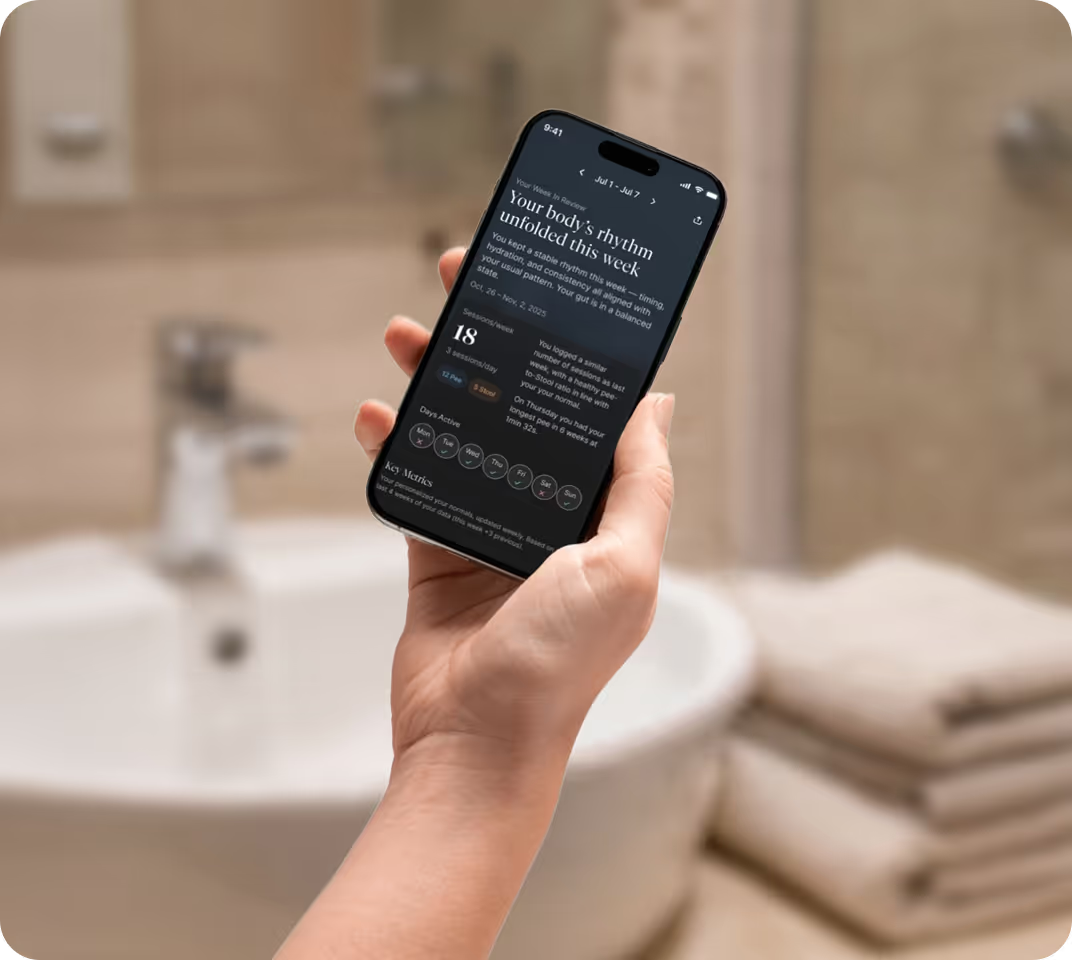
Your Body is Always Talking
You do your business. You see your data.
Throne is a smart sensor that clips onto your toilet and reads every session automatically — stool consistency, frequency, hydration, and regularity — without any logging. It turns the patterns you would never notice into personalized insight about your gut health and hydration.
How long does it last?
Usually not long. Anxiety poops tend to track your stress: the symptoms show up when the stressor does and settle once it passes, whether that's after the interview, the flight, or the hard conversation. A tense morning may mean one or several urgent trips, with symptoms easing as your nervous system settles.
If your gut stays disrupted long after the stress has lifted, or the pattern becomes a near-daily thing, that's a sign it's worth a closer look with a professional rather than just riding out.
How to calm anxiety poops
Anxiety poops can be hard to override once stress has set it in motion. But you can reduce the anxiety around it, both in the moment and over time.
In the moment:
- Slow your breathing. A few minutes of slow, controlled breathing, without forcing enormous breaths, can reduce the feeling of acute anxiety and help shift your body toward a calmer state. Try making the exhale slightly longer than the inhale.
- Don't fight the urge. Fighting the urge can add another layer of tension and worry. When a bathroom is available, giving yourself permission to go can take some pressure out of the situation.
- Name the loop: “I’m anxious that I’ll need the bathroom, and that worry is making my gut feel more urgent.” Recognizing the cycle doesn’t fix things instantly, but it can make it all feel less threatening.
Over time:
- Work on the baseline. When anxiety is the main trigger, the most useful long-term approach is often reducing the anxiety driving the pattern, not just reacting to the bowel symptoms. Regular exercise, adequate sleep and consistent stress-management practices can make your stress response less reactive over time.
- Steady your gut habits. Keep meals reasonably consistent, stay hydrated, and watch common triggers such as large amounts of caffeine and alcohol, both of which can worsen urgency or loose stool in some people. If fiber helps, gel-forming psyllium is generally more useful for loose stool than simply eating as much fiber as possible.
- Consider talking to someone. If anxiety is regularly disrupting your days, not just your digestion, that's worth talking to someone about. Therapy helps a lot of people with both the anxiety and the gut symptoms that ride along with it.
When it's worth talking to a doctor
Occasional stress-related trips to the bathroom are normal and not a cause for concern. But a few things are worth chatting with your doctor about.
If the pattern is frequent and persistent, especially recurrent abdominal pain alongside changes in how often you go or what your stool looks like, it may be worth being evaluated for IBS or another digestive condition. IBS is a common disorder of gut–brain interaction, and treatments are available.
And see a doctor sooner, separate from the anxiety, if you notice blood in your stool, black or tarry stools, unexplained weight loss, or symptoms that wake you from sleep. Those aren't typical of anxiety poops and deserve their own look.
Getting a clearer picture
When your gut and your stress are this tangled, it's genuinely hard to tell from memory whether a rough week was your nerves, something you ate, or a pattern worth acting on. Throne tracks what's easy to lose track of, how often you're going and whether your consistency is shifting over time, so you can see the pattern instead of trying to remember the pattern days later.
That's a clearer starting point for yourself, and a more useful one if you decide to talk your anxiety poops through with a doctor.
Frequently Asked Questions
Q: Why does anxiety make me poop?
A: In short, stress triggers your fight-or-flight response, which speeds up the muscle contractions in your colon through the gut-brain connection. Your body essentially tries to empty out before dealing with a perceived threat, which is why the urge hits fast when you're nervous.
Q: What does anxiety poop look like?
A: Usually looser and more urgent than your normal, since everything moved through faster than usual. It's sometimes green because rapid transit doesn't give bile time to turn fully brown. On its own, that's harmless.
Q: How long do anxiety poops last?
A: They tend to come and go with the stress that caused them, easing once the stressful moment passes. If your symptoms stick around long after the stress has lifted, or become a near-daily pattern, it's worth checking in with a doctor.
Q: Can anxiety cause constipation instead?
A: Yes. The gut-brain connection affects people differently. Stress speeds things up for some and slows them down for others, so anxiety can leave you constipated rather than running to the bathroom.
Breit, S., Kupferberg, A., Rogler, G., & Hasler, G. (2018). Vagus nerve as modulator of the brain-gut axis in psychiatric and inflammatory disorders. Frontiers in Psychiatry, 9, 44. https://doi.org/10.3389/fpsyt.2018.00044
Carabotti, M., Scirocco, A., Maselli, M. A., & Severi, C. (2015). The gut-brain axis: Interactions between enteric microbiota, central and enteric nervous systems. Annals of Gastroenterology, 28(2), 203–209. https://www.ncbi.nlm.nih.gov/pmc/articles/PMC4367209/
Margolis, K. G., Cryan, J. F., & Mayer, E. A. (2021). The microbiota-gut-brain axis: From motility to mood. Gastroenterology, 160(5), 1486–1501. https://doi.org/10.1053/j.gastro.2020.10.066
DISCLAIMER: This content is for informational purposes only and is not intended as medical advice. Throne products are not medical devices and are not intended to diagnose, treat, cure, or prevent any disease. Consult your physician with any health-related questions.