
IBS vs IBD: The Difference and How Doctors Tell Them Apart
IBS and IBD share symptoms but are different conditions. Here's how they differ, how doctors tell them apart, and why "which is worse" has a complicated answer.
Written by
Thomas Nelson
Published on
August 10, 2026

Overview
IBS and IBD share symptoms but are different conditions. Here's how they differ, how doctors tell them apart, and why "which is worse" has a complicated answer.


IBS and IBD can cause a lot of the same symptoms: diarrhea, abdominal pain, urgency, bloating, and bowel habits that suddenly seem to have a mind of their own.
But underneath those symptoms, they're very different conditions.
IBD causes measurable inflammation in the digestive tract. IBS doesn't. That difference changes what the conditions can do to your body, how doctors tell them apart, and what treatment looks like.
It also explains something that gets lost in the usual comparison. IBD is medically more serious, but that doesn't mean IBS can't make someone completely miserable.

Your body files a report daily
You do your business. You see your data.
Every trip to the bathroom is data waiting to be read. Throne clips onto your toilet and reads every session automatically: stool consistency, frequency, hydration, and regularity, with no manual logging. So when something changes, you're comparing to your real baseline instead of guessing.
The core difference
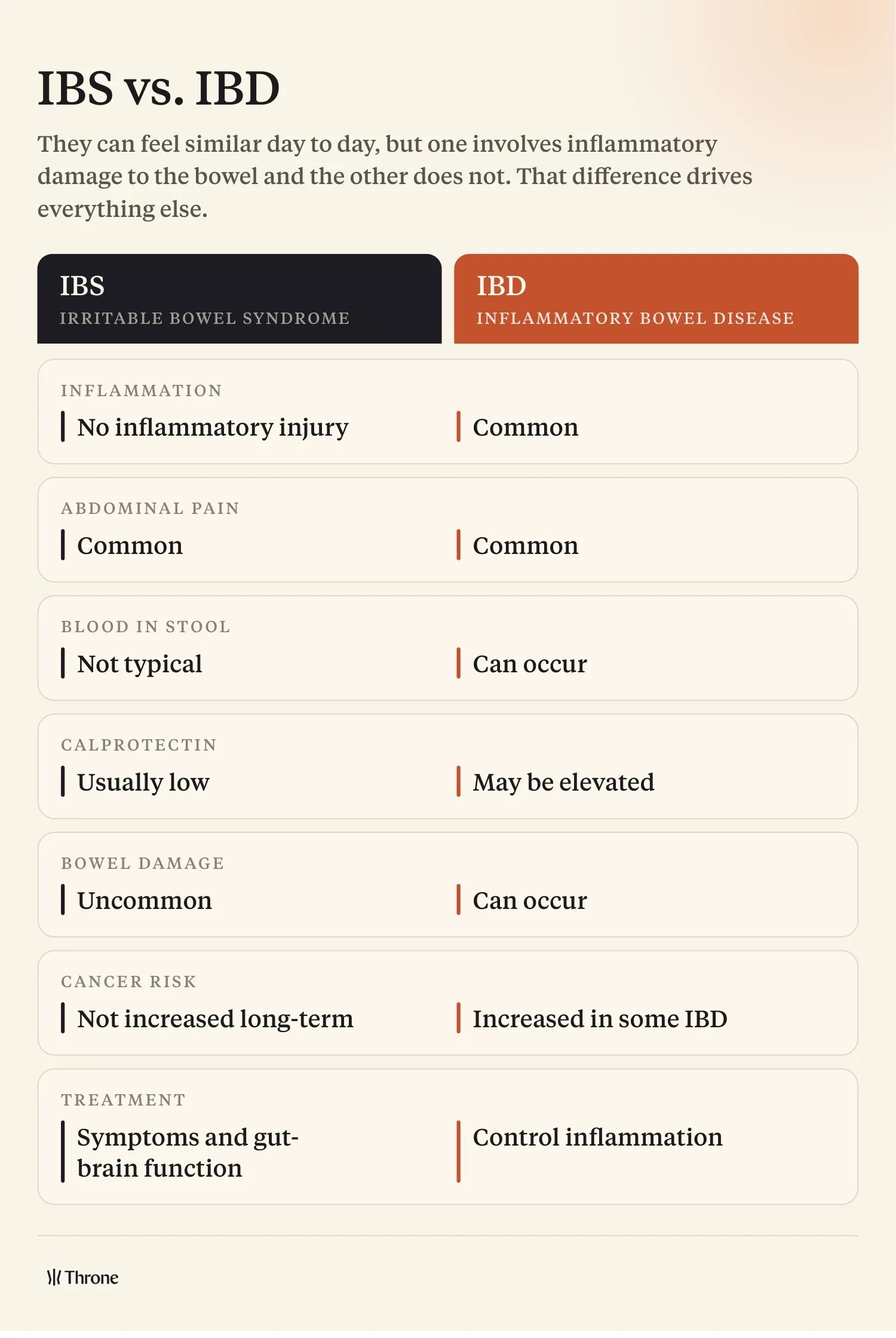
Inflammatory bowel disease, usually meaning Crohn's disease and ulcerative colitis, causes measurable inflammation in the digestive tract. Doctors can detect it with endoscopy and biopsies, with blood and stool markers, and, particularly in Crohn's disease, with imaging.
IBS doesn't. It affects how the gut functions and how it communicates with the brain, but its symptoms can still be severe.
That difference shapes how the two conditions are diagnosed, monitored, and treated.
Where the symptoms overlap, and where they don't
Both can cause abdominal pain, diarrhea, urgency, bloating, and a bowel habit that has clearly changed. On those symptoms alone, the two are hard to separate.
Some features shift the odds toward IBD:
- Blood in the stool
- Unintended weight loss
- Diarrhea that wakes you from sleep
- Fever, or fatigue that might reflect anemia
- Symptoms outside the gut, including joint pain, eye inflammation, or skin changes
None of those is required for IBD, and none of them rules IBS in or out on its own. They're reasons to test rather than conclusions.
IBS has one defining feature that's easy to miss: it requires recurrent abdominal pain linked to bowel movements or to changes in stool frequency or form. Loose stools without pain isn't IBS by the criteria, and that distinction matters, because it points toward a different set of explanations.
The part symptoms can't settle
What separates these two isn't usually one dramatic symptom. It's the pattern: what's happening, how often, whether it's changing, and what turns up alongside it. That's what a clinician is trying to assemble in the first ten minutes of an appointment, mostly from your memory.
Most people are working from impressions rather than records, and impressions skew toward whatever happened last week.
This is one place where Throne can be useful. It sits in your toilet and records the form and timing of every bowel movement automatically, so questions like "how often is it actually loose" and "has this changed since spring" become things you can look up.
That kind of record helps whether you're trying to understand an IBS pattern or living with IBD in remission. "It's been bad lately" is hard to work with. Something showing how often stool changed, when it changed, and whether the pattern stuck gives you and your clinician more to go on.
How doctors actually tell them apart
IBS is not diagnosed by ruling out everything else. The ACG guideline recommends a positive diagnostic strategy built on symptom criteria plus limited testing, rather than an open-ended hunt.
For someone with IBS-type diarrhea and no warning signs, that usually means a small amount of targeted testing rather than an exhaustive workup: celiac blood testing, and markers of inflammation such as fecal calprotectin or lactoferrin, sometimes alongside CRP. The same guideline recommends against routine colonoscopy in people under 45 without warning signs.
Fecal calprotectin is the workhorse here. It reflects neutrophil-driven inflammation in the intestine, so levels tend to rise when there's active inflammation, which is what makes it useful for separating IBD from a condition like IBS.
In a meta-analysis of 17 studies covering nearly 2,000 adults, it performed well at telling the two apart, with about 86% sensitivity and 92% specificity. Its real strength is ruling active IBD down when the result is low. A high result is less specific and needs context, since infections, NSAID use, and other conditions can raise it too.
A low calprotectin makes active IBD much less likely. A high one doesn't diagnose it.
Can you have IBS-like symptoms with IBD?
Yes, and this is the part most comparisons skip entirely.
Even when IBD is in remission, some people keep having abdominal pain, altered bowel habits, or bloating that look very much like IBS. A 2026 joint consensus from the Rome Foundation and IOIBD uses the term "IBD with IBS-like symptoms" for this, defined as those symptoms not explained by active inflammation or structural disease. It's treated as a recognized pattern rather than an assumption that you have two independent diseases.
This isn't rare. A meta-analysis of 3,169 patients with IBD in remission found about a third reported symptoms meeting criteria for IBS. When remission was confirmed by endoscopy rather than symptoms alone, the figure dropped to roughly a quarter, which suggests some of those symptoms were undetected inflammation. But not all of it.
If you have IBD and symptoms persist after active inflammation and structural problems have been reasonably excluded, that's a recognized clinical problem rather than you imagining things. Treating IBS-like symptoms is different from escalating IBD therapy.
So which one is worse?
This is the most common version of the question that doctors usually get, and it deserves a straight answer. "Worse" is measuring two different things.
On medical risk, IBD is the more serious condition. It involves inflammation that damages tissue, it can lead to complications requiring surgery, it needs ongoing treatment and monitoring, and it carries risks that IBS does not. IBS doesn't damage the bowel and isn't considered to increase your long-term risk of colorectal cancer.
On day-to-day burden, the difference can be much smaller. A hospital-based study comparing the two found quality-of-life scores similarly reduced in both groups. That was a single study at referral centers, so read it as a signal rather than a settled finding, and it doesn't mean the conditions are equivalent. What it does suggest is that how much a gut condition disrupts your life isn't reliably predicted by which label you have.
Being told you "only" have IBS can feel dismissive. A less dangerous condition is not the same as a less difficult one. IBS also has real treatments behind it: dietary approaches, medications, and gut-directed behavioral therapy all have evidence supporting them.
When to get checked
See a clinician rather than waiting if you have:
- Blood in the stool, or black, tarry stools
- Unintended weight loss
- Diarrhea that wakes you from sleep
- Fever, or unusual and persistent fatigue
- A family history of IBD or colorectal cancer
Symptoms that have changed and stayed changed are worth raising even without those features.
Frequently asked questions
Q: Which is worse, IBS or IBD?
A: IBD is more serious medically, because it damages the bowel and can cause complications. IBS doesn't. But symptom burden and quality-of-life impact can be comparable, so "worse" depends on whether you mean risk or daily experience.
Q: Can IBS turn into IBD?
A: No. IBS is not an early stage of IBD and doesn't turn into it. Someone diagnosed with IBS can later be found to have IBD, either because early IBD was hard to detect or because IBD developed later.
Q: Can a blood test tell them apart?
A: Not by itself. Blood tests including CRP are part of the picture, but stool calprotectin or lactoferrin is generally more useful for detecting intestinal inflammation. Confirming IBD usually involves endoscopy with biopsies, and suspected Crohn's disease may also require imaging or other small-bowel testing.
Q: Do I need a colonoscopy to know which one I have?
A: Not necessarily. Guidelines recommend against routine colonoscopy in people under 45 with IBS-type symptoms and no warning signs. Alarm features or abnormal inflammatory testing can make it appropriate. From age 45, colorectal cancer screening becomes a separate consideration, even if your symptoms still fit IBS.
Q: My calprotectin was slightly high. Does that mean IBD?
A: On its own, no. Mild elevations happen with infections, NSAIDs, and other causes. Depending on the number and your symptoms, repeating the test may be reasonable before moving to anything more invasive.
Exclusive Reader Offer
Take $50 off your Throne
Throne is the first hands-free sensor that automatically tracks your gut health, hydration, and urinary health, with every flush. Drop your email and we’ll send your $50-off code.
- Hands-free
- HSA/FSA eligible (saves 30%)
- 30-Day Battery
- 6 Private Profiles
Claim your $50
Thank you! Your submission has been received!
Oops! Something went wrong while submitting the form.
Lacy, B. E., Pimentel, M., Brenner, D. M., Chey, W. D., Keefer, L. A., Long, M. D., & Moshiree, B. (2021). ACG clinical guideline: Management of irritable bowel syndrome. American Journal of Gastroenterology, 116(1), 17-44.
Fairbrass, K. M., Costantino, S. J., Gracie, D. J., & Ford, A. C. (2020). Prevalence of irritable bowel syndrome-type symptoms in patients with inflammatory bowel disease in remission: A systematic review and meta-analysis. Lancet Gastroenterology & Hepatology, 5(12), 1053-1062.
Halpin, S. J., & Ford, A. C. (2012). Prevalence of symptoms meeting criteria for irritable bowel syndrome in inflammatory bowel disease: Systematic review and meta-analysis. American Journal of Gastroenterology, 107(10), 1474-1482.
Systematic review with meta-analysis: Diagnostic performance of faecal calprotectin in distinguishing inflammatory bowel disease from irritable bowel syndrome in adults. (2023). Alimentary Pharmacology & Therapeutics. PMID: 37823411.
Recommendations for the evaluation and management of inflammatory bowel disease with irritable bowel syndrome-like symptoms: A joint Rome Foundation and International Organization for the Study of IBD (IOIBD) consensus. (2026). Gastroenterology. Published online April 29, 2026. PMID: 42066865.
Mearin, F., Lacy, B. E., Chang, L., Chey, W. D., Lembo, A. J., Simren, M., & Spiller, R. (2016). Bowel disorders. Gastroenterology, 150(6), 1393-1407.
Pace, F., Molteni, P., Bollani, S., Sarzi-Puttini, P., Stockbrügger, R., Bianchi Porro, G., & Drossman, D. A. (2003). Inflammatory bowel disease versus irritable bowel syndrome: A hospital-based, case-control study of disease impact on quality of life. Scandinavian
DISCLAIMER: This content is for informational purposes only and is not intended as medical advice. Throne products are not medical devices and are not intended to diagnose, treat, cure, or prevent any disease. Consult your physician with any health-related questions.