
Is One Long, Continuous Poop Good or Bad?
Wondering if a long, continuous poop is healthy? Learn what stool length, color and texture really mean and when to talk to your doctor.
Written by
Thomas Nelson
Published on
July 6, 2026
Overview
Wondering if a long, continuous poop is healthy? Learn what stool length, color and texture really mean and when to talk to your doctor.


A good bowel movement can feel like proof you're doing everything right with your health. But what does it mean when you have one, continuous, long poop?
The truth is, length is one of the least useful things you can judge a poop by. A long one usually just means you're getting enough fiber and water, which is good, but a shorter or more broken-up poop can be every bit as healthy. Think of your stool as a vital reading on your body’s internal dashboard. It provides data, but it's rarely a verdict on its own
What your body is actually reporting on is harder to see in a single trip to the bathroom. How easily things pass, and whether your normal has changed, is the real signal to learn to read.
What determines your poop's length and shape
Poop is shaped by what goes in and how your body moves it along, and normal covers a wide range. A few ordinary lifestyle factors have most of the impact.
Fiber and water make stool moldable. Fiber adds bulk, water keeps it soft, and together they help stool hold together as it moves. Skimp on either and it can turn drier and more broken-up.
Fat that isn't absorbed can make stool pale, bulky, loose, smelly, and prone to floating. Usually your body absorbs fat well, but when a lot slips through, it can point to a very high-fat diet or to something not absorbing the way it should.
Transit time, how long food takes to get from plate to toilet, has one of the larger impacts on consistency. Too fast and the colon can't pull out enough water, so stool comes out loose. Too slow and it pulls out too much, leaving it hard and pellet-like.
Your anatomy matters too. A longer, roomier rectum tends to produce one continuous poop; a shorter one breaks it into pieces. When your pelvic floor relaxes properly, things pass easily; when it stays tense, you strain. None of this is something you did wrong. It's just your plumbing, and everyone's is built a little differently.
When is a long poop "normal"?
Long, continuous poop is almost always normal as long as it's comfortable to pass and nothing else has changed. A long, smooth poop usually just means you're well-fed on fiber and well-hydrated.
The more useful question is how easy your poop is to pass, its consistency, and whether any of it has shifted from your usual pattern is more important information. Those tell you far more than whether it came out in one piece or three.
If you have any concerns, it can be helpful to track your poop. Consider keeping a diary and taking notes when you notice any change. This can be especially important if you are living with any health conditions or taking any medications.
Why your poop changes day to day
Beyond fiber, water, and transit, plenty of ordinary things nudge the shape of your poop around, which is why it's rarely identical two days in a row. Bigger meals make more stool, no surprise there. Exercise helps keep things moving, while sitting still slows your transit time down. Holding it in when you're busy lets the colon pull out more water, so what finally gets passed is harder and less comfortable.
Some changes have a clearer cause. Medications are a common one: opioids, iron, and some antidepressants firm things up, while antibiotics and laxatives can loosen them.
Ongoing conditions like IBS, IBD, or celiac disease can also reshape your stool in lasting ways.
When a change is worth paying attention to
Most shifts in your poop are just your body responding to what you ate, how much you moved, or how stressed you've been that week. These shifts are usually temporary and will pass on their own. A few patterns, though, are worth noticing. And the key word is patterns.
Let's start with the one people worry about most: thin, pencil-like, or ribbon-shaped stool. You’ve probably heard that this is a sign of colon cancer. The research doesn't actually support that link. On its own, narrow stool is far more often the result of something benign, like straining, hemorrhoids, or a bout of IBS.
What earns a doctor's visit is a narrow stool that persists, especially if it shows up alongside other signals, like bleeding, unexplained weight loss, or ongoing pain. A lasting change plus other concerning symptoms is the thing to act on.
The same logic covers the rest. A single day of pellets or an off-looking poop usually isn’t worth a second thought. What's worth a mention to your doctor is a clear shift from your own normal that lasts more than a week or two, especially if something else feels off alongside it. You don't need to track every trip to the bathroom or diagnose yourself from the throne. You just need to know your baseline well enough to notice when it changes.
What a healthy poop actually looks like
The most useful tool for this isn't a rule, it's a picture. In 1997, researchers in Bristol built a simple scale that sorts poop into seven types, from hard pebbles to liquid, and it's since become the standard way to describe something that can be awkward to talk about.
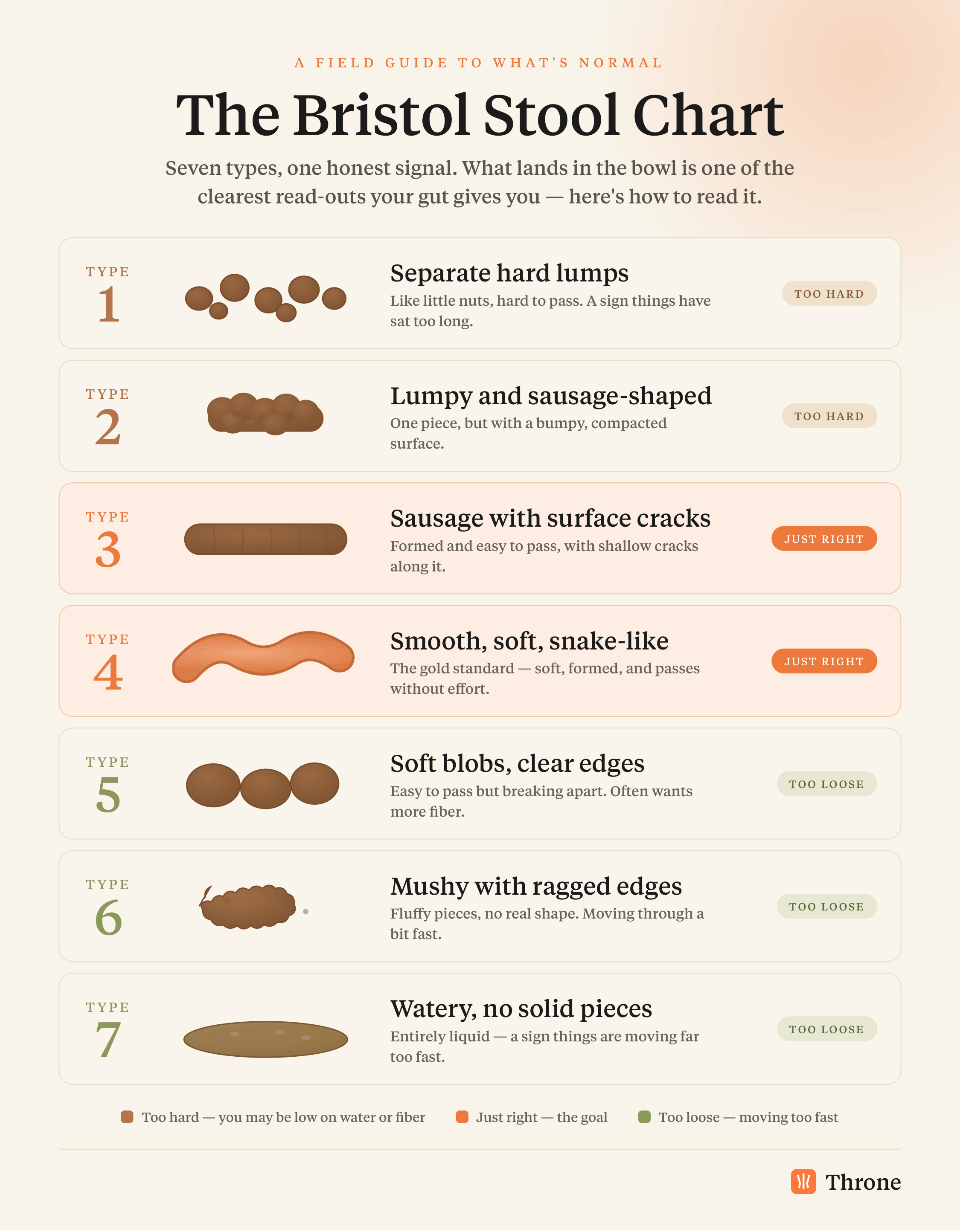
Types 3 and 4, the smooth, soft, sausage-shaped ones, are the sweet spot: those are a sign you’re well-hydrated, things are moving at a good pace, and poop is easy to pass. Types 1 and 2 lean toward constipation and usually mean more fiber and water would help. Types 5 through 7 lean the other way, toward loose or watery, which can follow a sudden diet change, a bug, or something your gut didn't agree with.
The chart is a great starting point for a conversation, but it can’t diagnose anything. It's a visual read, not a lab measurement, so use it to notice patterns and describe them, not to grade yourself. A single Type 6 morning isn't a diagnosis of anything. A “normal” that changes long-term is the thing to keep your eye on.
Your Body is Always Talking
You do your business. You see your data.
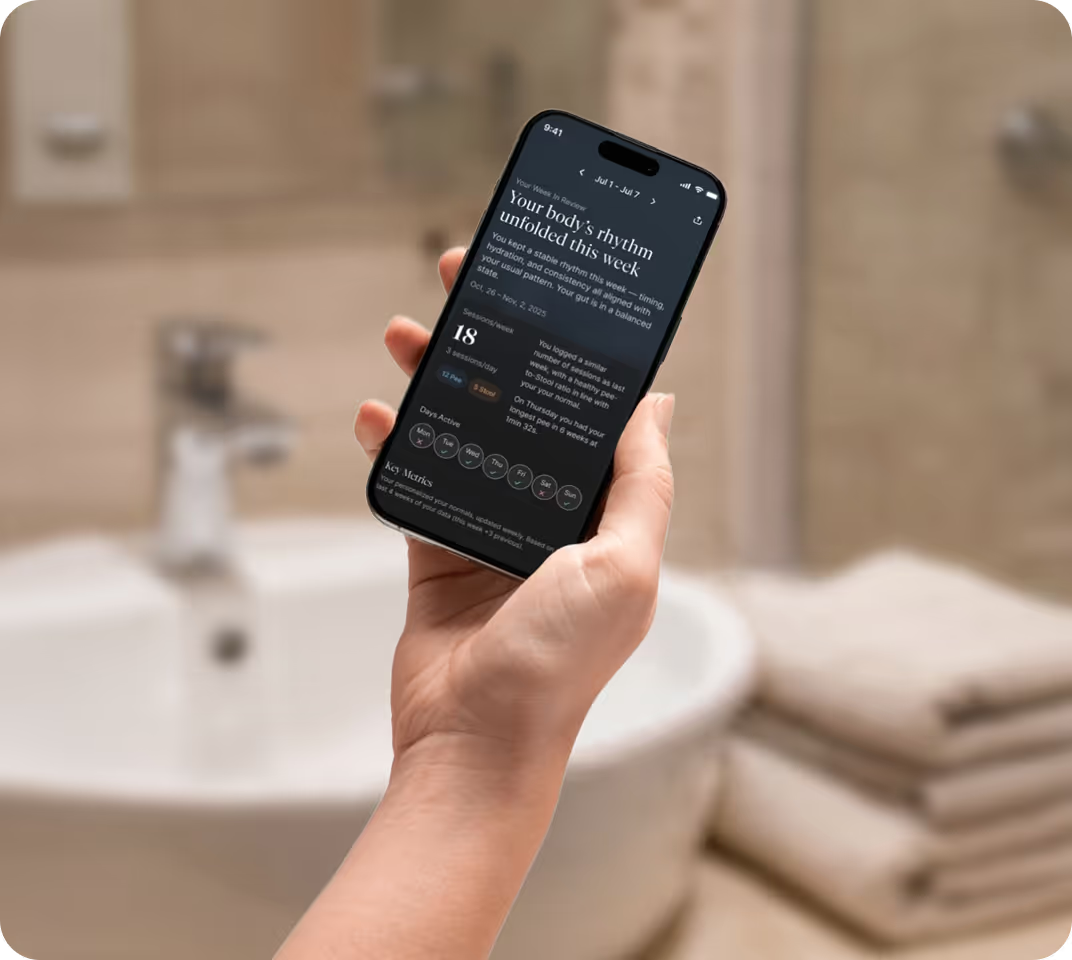
Throne is a smart sensor that clips onto your toilet and reads every session automatically — stool consistency, frequency, hydration, and regularity — without any logging. It turns the patterns you would never notice into personalized insight about your gut health and hydration.
How to support easier, healthier bowel movements
A good poop is soft, well-formed, and passed easily without pain. “The enemy of a good stool is a perfect stool,” says Bryan Curtin, MD, a board certified gastroenterologist who specializes in GI motility disorders. You don’t want to chase vanity metrics like length, or shape, but you do want to have easy, normal bowel movements.
If yours tends to run too hard, too loose, or puts up too much of a fight, a handful of basics fix most of it.
Don't ignore the urge. When you’ve got to go, go. Dr. Carmen Fong calls this the One Poop Commandment: put it off too often and the stool just sits there, the colon pulls more water out of it, and what you're left with is harder and more broken-up. Answering the call when it comes is the single easiest thing on this list.
Eat more fiber from more places. Aim for the 25 to 35 grams a day Fong recommends, and get it from a mix of sources: fruit, vegetables, whole grains, beans, and classics like prunes. Soluble and insoluble fiber do slightly different jobs, so variety beats loading up on any one food.
Drink enough, and count everything. General targets land around 15.5 cups of fluid a day for men and 11.5 for women, but that's total fluid, not glasses of plain water. What you drink with meals, plus the water in food, coffee, and tea, all counts toward it.
Move. Physical activity nudges the muscles of your digestive tract to keep things moving. A walk after meals does more than you'd expect, and sitting still all day is often the underappreciated reason things slow down.
Manage your stress. Your stress shows up in your gut too, not just your head. Stress can tip some people toward constipation, looser, more urgent stools for others.
Know your normal. The most useful habit here isn't chasing a perfect poop, but more knowing your own baseline well enough to notice when it genuinely shifts and stays shifted. That's the difference between a one-off and a signal.
It is also a good idea to avoid:
- Straining to force poop out at the toilet
- Lingering on the toilet
- Taking laxatives without a doctor’s guidance
- Ignoring strange changes
- Holding it in or ignoring the call
Can continuous tracking help?
Judging your gut health from a single bowel movement isn't very useful. It can make you anxious when nothing's wrong, or falsely reassured when a bigger pattern is starting to form. Tracking helps because bowel habits are about patterns, not one-off events. Consistently hard stools may point to low fiber or constipation. Frequent loose ones may flag a dietary trigger or another digestive issue.
This is where tracking can help, especially if you tend to forget details or only notice your bowel habits when something feels wrong. A smart toilet sensor like Throne takes the guesswork out of it and actually records patterns in frequency, consistency, color, and change over time. The goal isn’t to obsess over every bowel movement, but to build a clearer baseline, so you can tell the difference between one weird day and a pattern worth discussing with your doctor.
When to see a doctor
Most of what your poop does is normal variation. A few things are worth a conversation during your next doctor visit, and a few are worth an urgent call.
It's worth mentioning at your next visit if you have a clear change from your own normal that sticks around longer than two weeks, whether that's how often you go, how your stool is formed, or how easy it is to pass.
It's worth an urgent call if there's visible blood, black or tarry stools, unexplained weight loss, persistent or severe abdominal pain, a swollen belly or a lump you can feel, or ongoing nausea and vomiting. These don't always mean something is seriously wrong, but they're the signs worth having checked sooner rather than later.
Frequently Asked Questions
Q: Does a long poop mean my digestive system is perfectly healthy?
A: Not on its own. A long, smooth poop usually just means you're getting enough fiber and water to hold it together, which is a good sign, but it's only one piece. What actually says "healthy" is stool that's easy to pass, fairly consistent, and hasn't changed much from your normal. Length is nice. It isn't the scorecard.
Q: Why is my poop suddenly coming out in short pieces instead of one long log?
A: Usually it's something minor: a little dehydration or a dip in fiber, so things move slower and break apart on the way out. Stress or a change in your routine can do it too. A day or two like this is nothing to read into. It's only worth attention if it sticks around.
Q: Can stress affect my stool's shape?
A: Definitely. Your gut is unusually tuned in to stress, and it shows. For some people stress speeds things up and loosens them; for others it slows things down and hardens them. If your poop goes sideways during a rough week, that's often all it is.
Q: How often should I actually check my stool?
A: A glance is plenty, no need to study it. Tracking over weeks, by hand or automatically, tells you far more than obsessing over any single day, since it's the pattern that matters. And if checking starts making you anxious, ease off. The point is knowing your normal, not policing every trip.
Exclusive Reader Offer
Take $50 off your Throne
Throne is the first hands-free sensor that automatically tracks your gut health, hydration, and urinary health, with every flush. Drop your email and we’ll send your $50-off code.
- Hands-free
- HSA/FSA eligible (saves 30%)
- 30-Day Battery
- 6 Private Profiles
Claim your $50
Thank you! Your submission has been received!
Oops! Something went wrong while submitting the form.
1. InformedHealth.org [Internet]. Cologne, Germany: Institute for Quality and Efficiency in Health Care (IQWiG); 2006-. In brief: How do bowel movements work? 2021 Dec 13. Available from: https://www.ncbi.nlm.nih.gov/books/NBK279481/
2. Annahazi A, Schemann M. From watery and fluffy to soft and formed: What shapes our stool? J Physiol. 2021 Oct;599(20):4521-4522. doi: 10.1113/JP282280. Epub 2021 Sep 20. PMID: 34542172.
3. de Wit N, Esser D, Siebelink E, Fischer A, Sieg J, Mes J. Extrinsic wheat fibre consumption enhances faecal bulk and stool frequency; a randomized controlled trial. Food Funct. 2019 Feb 20;10(2):646-651. doi: 10.1039/c8fo01649f. PMID: 30652171.
4. Gonçalves GVR, Canova R, Callegari-Jacques SM, Frandoloso R, Kreutz LC, Fornari F. Short-term intestinal effects of water intake in fibre supplementation in healthy, low-habitual fibre consumers: a phase 2 clinical trial. Int J Food Sci Nutr. 2022 Sep;73(6):841-849. doi: 10.1080/09637486.2022.2079117. Epub 2022 May 23. PMID: 35603590.
5. Azer SA, Sankararaman S. Steatorrhea. 2023 May 16. In: StatPearls [Internet]. Treasure Island (FL): StatPearls Publishing; 2026 Jan–. PMID: 31082099.
6. Jaruvongvanich V, Patcharatrakul T, Gonlachanvit S. Prediction of Delayed Colonic Transit Using Bristol Stool Form and Stool Frequency in Eastern Constipated Patients: A Difference From the West. J Neurogastroenterol Motil. 2017 Oct 30;23(4):561-568. doi: 10.5056/jnm17022. PMID: 28738452; PMCID: PMC5628989.
7. Borhan-Manesh F. "Low caliber stool" and "pencil thin stool" are not signs of colo-rectal cancer. Dig Dis Sci. 2009 Feb;54(2):208-11. doi: 10.1007/s10620-008-0356-1. Epub 2008 Aug 6. PMID: 18683051.
8. Lewis SJ, Heaton KW. Stool form scale as a useful guide to intestinal transit time. Scand J Gastroenterol. 1997 Sep;32(9):920-4. doi: 10.3109/00365529709011203. PMID: 9299672.
DISCLAIMER: This content is for informational purposes only and is not intended as medical advice. Throne products are not medical devices and are not intended to diagnose, treat, cure, or prevent any disease. Consult your physician with any health-related questions.