
The Ultimate Guide to Poop
Your poop is one of the most consistent health signals your body produces every day. This guide breaks down what it should look like, what influences it, and what changes in color, consistency, and frequency are telling you about your health.
Written by
Sara Rivera
Published on
June 15, 2026
Overview
Your poop is one of the most consistent health signals your body produces every day. This guide breaks down what it should look like, what influences it, and what changes in color, consistency, and frequency are telling you about your health.


Every day your body produces a detailed report on your internal health. It tells you how well you're digesting food, how hydrated you are, whether your gut bacteria are thriving, and if something bigger might be going wrong. Most people use the bathroom, look away, flush it, and never think about it again. That is the whole problem.
Stool is one of the few outputs your body generates continuously that reflects multiple systems at once. Color and consistency signal digestive efficiency. Form and odor reflect the state of the gut microbiome. Water content and transit speed communicate hydration status. Frequency and ease of passage reflect how well the nervous system and gut are coordinating. Changes in any of these show up within 24 to 48 hours of a dietary shift, faster than almost any other health signal your body produces.
The challenge isn't that the information is unavailable. It's that most people never track their poop efficiently to build a baseline consistent enough to notice when something has shifted.
This guide covers how to read what your poop looks like, what influences it, and what it might be signaling about your broader health, including things you would never think to connect to what ends up in the toilet bowl. Before getting into the mechanics, it helps to know what to actually watch out for.
When Your Poop Is Telling You Something Is Wrong
Not every change in your bowel habits is a cause for concern. The gut is sensitive to daily life, and occasional variation in stool form and frequency is completely normal. What is worth paying attention to is a change that persists for more than a few days, gets worse over time, or arrives alongside other symptoms that feel out of the ordinary. Constipation and diarrhea are the two most recognizable signals, but they are rarely the whole story. They are symptoms pointing at something else. The more important question in both cases is why, and the answer is often something most people would never think to connect to their gut.
- Persistent loose stool accompanied by bloating and cramping may indicate irritable bowel syndrome (IBS), which affects roughly 10 to 15 percent of the population and is frequently underdiagnosed. [6]
- Chronic loose stool with urgency can be a sign of inflammatory bowel disease (IBD).
- Hypothyroidism is a frequently overlooked cause of persistent constipation because an underactive thyroid slows the muscle contractions that move stool through the colon. This often goes undiagnosed for months.
- Pale, greasy stool that floats can indicate malabsorption conditions affecting the pancreas or small intestine.
- Changes in bowel habits that accompany unexplained weight loss, fatigue, or blood in the stool are always worth investigating, not because they are automatically serious, but because your poop in those cases is doing exactly what it is designed to do: flag that something in your body needs attention.
Understanding what those signals mean starts with understanding what poop actually is and where it comes from. Most people have never thought about it that deeply, but the mechanics turn out to be the key to reading it correctly.
What Poop Actually Is
Most people think of stool as leftover food the body couldn't use. That's technically true, but it undersells what stool actually tells you. It's a downstream readout of nearly every biological system in your body. Once you understand that, you can read the full story it's telling you about your health.
From Food To Stool
By the time food becomes stool, it has passed through a sequence of biological processes. Breakdown begins in the mouth and continues in the stomach. Enzymatic digestion in the small intestine reduces food to its molecular components, and the intestinal lining absorbs nutrients, minerals, and water across a surface area roughly the size of a studio apartment when fully unfolded. What has not been absorbed by that lining enters the colon, where microbial fermentation continues and the final extraction of water and electrolytes takes place before elimination.
What exits the body is a mixture of water, undigested fiber, gut bacteria, and waste. Most of what gives stool its consistency comes down to one thing, water. How much water the colon pulls out of stool before elimination is directly tied to how hydrated your body is at any given time.
Now that you know what poop is made of, you can start to understand what it should look like when everything is working the way it should.
What Your Poop Should Look Like
One of the most common misconceptions about gut health is that there's a single correct version of normal. There isn't. What actually matters is consistency within your own pattern and whether anything has meaningfully shifted from your personal baseline.
The Bristol Stool Scale
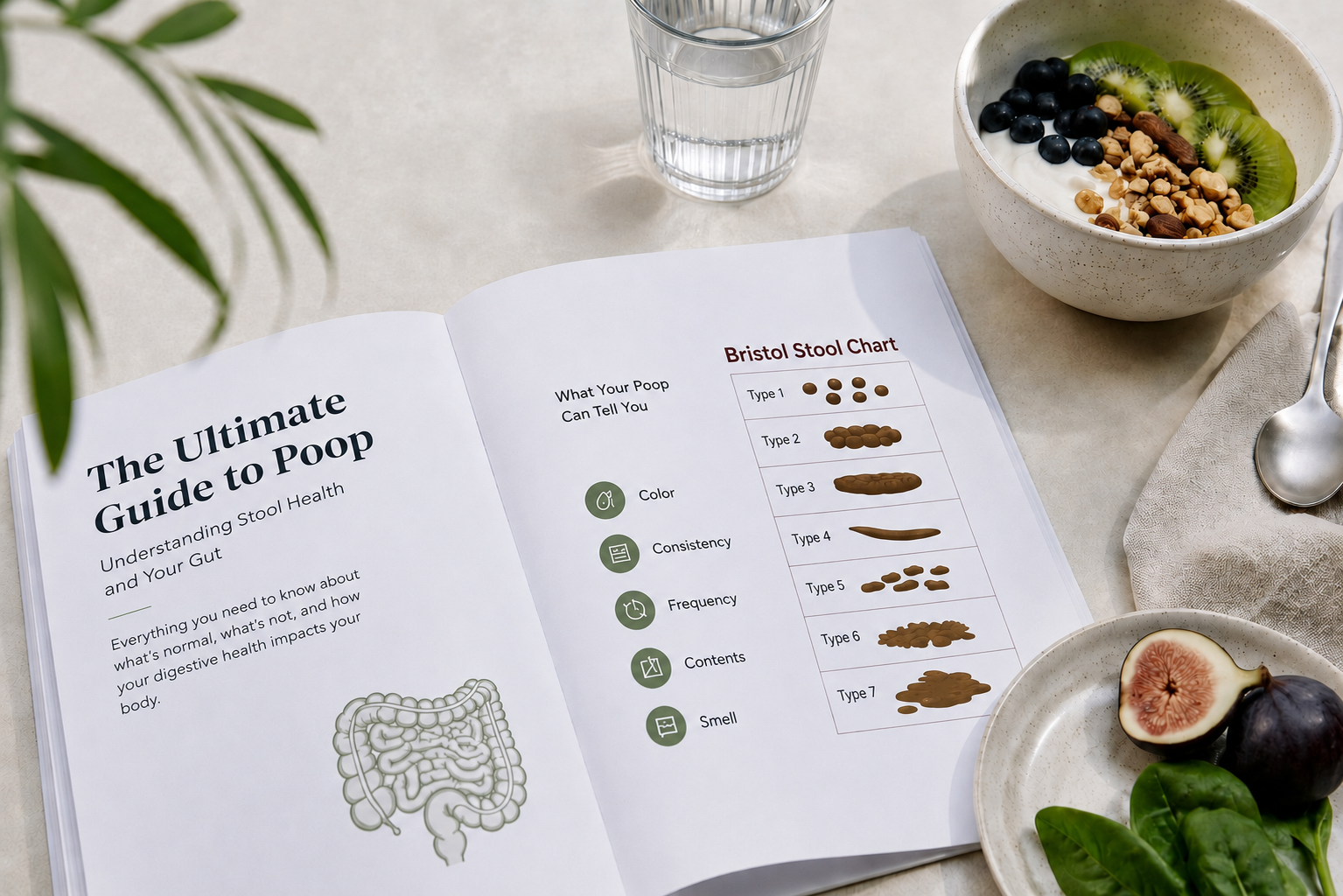
The Bristol Stool Form Scale classifies stool into seven types based on form and consistency. It's the most widely used clinical reference for understanding what your poop is telling you about how quickly food is moving through your digestive system, a measurement called transit time. Transit time matters because it's connected to the hydration story above, and because it reflects how your gut is actually functioning. Slow transit means the colon has more time to extract water, producing harder stool. Fast transit means the opposite. Here is the scale broken down.
- Types 1 and 2 are hard separate lumps or a lumpy sausage shape. This indicates slow transit and too much water being extracted in the colon.
- Types 3 and 4 are a smooth sausage shape with or without surface cracks. This is the physiological ideal associated with comfortable passage and balanced transit time.
- Type 5 is soft blobs with clear cut edges. This indicates slightly faster than ideal transit and is often a sign of insufficient fiber or mild digestive disruption.
- Types 6 and 7 are fluffy or entirely liquid stool. This indicates rapid transit and not enough water absorption.
This scale is a reliable tool for identifying change and figuring out what your normal looks like. Once you know what your normal looks like, a shift in type becomes a signal worth paying attention to.

Your Body is Always Talking
You do your business. You see your data.
Throne is a smart sensor that clips onto your toilet and reads every session automatically — stool consistency, frequency, hydration, and regularity — without any logging. It turns the patterns you would never notice into personalized insight about your gut health and hydration.
How Often You Should Poop
How often you should poop is one of the most misunderstood questions in gut health. The answer has more to do with your personal baseline than any number you have been told to hit. One to three times per day is the range most associated with healthy digestion, adequate hydration, and a well-functioning microbiome. But frequency alone doesn't tell the whole story. Going too slow means the colon has more time to pull water out of stool, making it harder to pass. Going too fast means it is not absorbing enough water, which is what produces loose or liquid stool. Both ends of the spectrum are telling you something specific: either your gut is stalling or rushing, and neither is working the way it should.
Instead of thinking about hitting a specific number, focus on whether your pattern is consistent and comfortable. Your personal baseline is more meaningful than the population average. If your frequency has shifted noticeably over several weeks without an obvious explanation, that shift is worth paying attention to. [6]
What Poop Color Means
The color of your poop is another informative signal. Color is primarily determined by bile, a digestive fluid produced by the liver that changes as it moves through the digestive tract. It is also influenced by what you have been eating. Knowing what each shade means makes it much easier to tell the difference between something you ate yesterday and something worth investigating.
- Brown is the healthy baseline. Bile starts out greenish yellow and gradually turns brown as it moves through the colon. Any shade of brown from light tan to dark chocolate is generally normal.
- Green is usually a transit issue rather than a health problem. When stool moves through the colon faster than usual, bile doesn't have enough time to fully convert to brown. Leafy greens, green food dye, and iron supplements can also temporarily turn stool green.
- Yellow often reflects excess fat in the stool, which can happen after a particularly fatty meal, during a bout of diarrhea, or with certain digestive conditions that affect fat absorption. Occasional yellow stool is usually harmless. Persistent yellow stool with a greasy or foul-smelling character is worth mentioning to a doctor.
- Pale, grey, or clay colored can indicate reduced bile flow, which may be related to the liver, gallbladder, or bile ducts. Important to flag this to your doctor if it persists for more than a day or two.
Two colors that should prompt a call to your doctor rather than a wait-and-see approach are black tarry stool, which can indicate bleeding in the upper digestive tract, and bright red blood in or on stool, which typically points to something lower in the digestive tract. Neither is automatically an emergency but both deserve clinical attention.
What Impacts Your Poop
Poop doesn't change randomly. The characteristics you observe — consistency, color, frequency — are downstream effects of a handful of inputs. Understanding those inputs is what lets you actually read what your stool is telling you. The biggest ones are fiber, the gut microbiome, water, and two that most people never think to connect to their gut: mediations and hormones.
How Fiber and Your Gut Microbiome Shape Your Poop
Your gut microbiome is the community of trillions of bacteria living in your colon, and fiber is what keeps them functioning. The more diverse and consistent your fiber intake, the better your gut bacteria perform, and that shows up directly in your poop.
There are two types of fiber and both perform different jobs in the gut.
- Soluble fiber dissolves in water and forms a gel-like substance in the digestive tract that slows digestion and contributes to stool softness by retaining water within intestinal contents. Good sources include oats, legumes, apples, and psyllium husk.
- Insoluble fiber adds bulk to stool and pushes against the colon wall, signaling it to contract and keep things moving. Good sources include almonds, chickpeas, lentils, green beans, and quinoa.
When fiber intake drops, the gut bacteria that fuel the colon lining and keep digestion running smoothly start to decline. Less of that fuel means slower gut motility, harder stool, and a gut environment that becomes harder to keep in balance. When those populations are abundant and diverse, stool tends to be well-formed and transit tends to be regular. [1]
Variety matters just as much as volume. Eating the same two or three high-fiber foods every day feeds a narrow range of bacterial species. Eating a wider variety of soluble and insoluble fiber feeds a broader bacterial community and produces a more stable, better-functioning gut. [2]
How Water Affects Every Bathroom Visit
Most people know hydration matters, but few connect it directly to pooping. When you are even mildly dehydrated, your colon compensates by pulling more water out of stool than it normally would. The result is harder, slower-moving stool that is more difficult to pass. Most people never trace that back to how much they drank the day before and do not realize that hydration and transit time are working simultaneously. [4]
Dehydration can cause the colon to deliberately slow transit so it has more time to extract water from stool. But slow transit from other causes, like low fiber intake or poor gut motility, also results in harder stool simply because it sits in the colon longer and more water gets pulled out over time. Either way the result is the same. Hydration is one of the most direct levers you have to influence both transit time and stool consistency.
Additionally, if you are increasing your fiber intake, water becomes even more important. Fiber adds bulk, but it needs fluid to move through the colon efficiently. Without enough water, more fiber just means more stool sitting in place.
How Medications Affect Your Poop
Gastrointestinal (GI) side effects are among the most common reactions to medication. Antibiotics disrupt the gut microbiome within days, frequently producing loose stool during the course and sometimes leaving a bacterial imbalance that lingers for weeks after. Opioid pain medications suppress gut contractions and produce constipation that does not respond well to fiber or water alone. Iron supplements predictably darken stool and often cause constipation or nausea.
How Hormones Affect Your Poop
The gut is deeply sensitive to hormonal shifts, which means stool patterns can change significantly without any change in what you ate or drank. Progesterone relaxes the smooth muscle lining the digestive tract, slowing transit, which is why many women experience constipation during the second half of their menstrual cycle and throughout pregnancy. [5] Cortisol does the opposite, producing the urgency and loose stool most people recognize as a physical stress response. [7] Thyroid hormones matter too. Hypothyroidism is a frequently overlooked cause of persistent constipation, while hyperthyroidism can produce chronic loose stool that does not resolve until thyroid function is addressed.
How to Improve Your Poop Starting Today
Everything covered in this guide points back to the same idea: your poop is a direct reflection of what is happening inside your body, and improving it comes down to the same handful of things.
Increase fiber diversity rather than just fiber volume
Aim for 30 or more distinct plant species per week across vegetables, fruits, legumes, nuts, seeds, and whole grains. Plant food diversity is the most reliable dietary predictor of microbial diversity, and microbial diversity is directly reflected in stool quality, consistency, and regularity.[2]
Hydrate before you add fiber
Increasing fiber intake without increasing fluid intake can worsen constipation by adding bulk without the water needed to move it. Starting the day with 400 to 500 milliliters of water before coffee or food addresses the overnight fluid deficit and supports the morning motility surge the gut is already primed to produce.[4]
Protect your morning motility window
The gastrocolic reflex is strongest in the morning when gut motility is already elevated. Eating breakfast at a consistent time and spending five minutes of slow breathing before or after breakfast gives the gut the calm, ready state it needs to complete a bowel movement efficiently. Rushed mornings work against this window. [5]
Support your microbiome through fermented foods
Fermented foods including yogurt, kefir, kimchi, sauerkraut, and miso provide direct microbial inputs that support the diversity of the gut ecosystem alongside fiber-rich plant foods. Together they create the conditions for a microbiome that keeps your colon lining healthy, supports consistent well-formed stool, and keeps your gut functioning the way it should. [3]
Move your body consistently
Physical activity stimulates gut motility through both mechanical and neurological means. Even 20 to 30 minutes of walking per day produces measurable improvements in transit time and stool consistency over time, particularly for people who tend toward constipation. [6]
- Anderson JW, Baird P, Davis RH Jr, et al. Health benefits of dietary fiber. Nutrition Reviews. 2009;67(4):188-205.
- Valdes AM, Walter J, Segal E, Spector TD. Role of the gut microbiota in nutrition and health. BMJ. 2018;361:k2179.
- Sonnenburg JL, Backhed F. Diet-microbiota interactions as moderators of human metabolism. Nature. 2016;535(7610):56-64.
- Binder HJ. Role of colonic short-chain fatty acid transport in diarrhea. Annual Review of Physiology. 2010;72:297-313.
- Konturek PC, Brzozowski T, Konturek SJ. Gut clock: implication of circadian rhythms in the gastrointestinal tract. Journal of Physiology and Pharmacology. 2011;62(2):139-150.
- Bharucha AE, Pemberton JH, Locke GR 3rd. American Gastroenterological Association technical review on constipation. Gastroenterology. 2013;144(1):218-238.
- Soderholm JD, Perdue MH. Stress and gastrointestinal tract II: stress and intestinal barrier function. American Journal of Physiology. 2001;280(1):G7-G13.
DISCLAIMER: This content is for informational purposes only and is not intended as medical advice. Throne products are not medical devices and are not intended to diagnose, treat, cure, or prevent any disease. Consult your physician with any health-related questions.