
Why Do I Poop So Much on My Period? What's Actually Going On
Your period starts, and suddenly you're in the bathroom more than usual. It's common, but there are reasons you may want to discuss it with your doctor.
Written by
Thomas Nelson
Published on
July 27, 2026

Overview
Your period starts, and suddenly you're in the bathroom more than usual. It's common, but there are reasons you may want to discuss it with your doctor.


Your period starts, and suddenly you're in the bathroom more than usual, with looser stools and worse timing than any other week of the month.
You're not imagining it, and it's common. Bowel habits really do shift around menstruation, the change tends to land hardest right as bleeding begins, and for most people it isn't a sign of anything wrong.
The part you actually want is usually missing: how much of this is normal, whether yours fits the usual pattern, and when it's worth a closer look. That last question is hard, because it depends on your own baseline, and most people don't have one. You remember this period was rough. You don't remember how the last four compared.
That's where Throne helps. It automatically records the bowel side of the picture, your stool form and how often you go, so you have a baseline to compare against rather than reconstructing weeks from memory. To be clear about the limits: it doesn't diagnose anything, and it doesn't track your cycle. You bring the cycle dates; it brings the bowel record.
What actually changes when your period starts
In a prospective study, 78 healthy women ages 18 to 35 who were taking oral contraceptives logged their bowel habits every single day across the menstrual cycle. Stool frequency, stool form, and symptoms like diarrhea and abdominal pain all shifted with the cycle and peaked on the first day of bleeding.
So more trips to the bathroom, and looser stools when you get there, is a documented pattern, most intense right as your period begins and easing over the following days. If that matches what you feel, you're squarely in normal territory.
Your gut isn't misbehaving, just doing an ordinary thing that tends to cluster on the first day of bleeding.
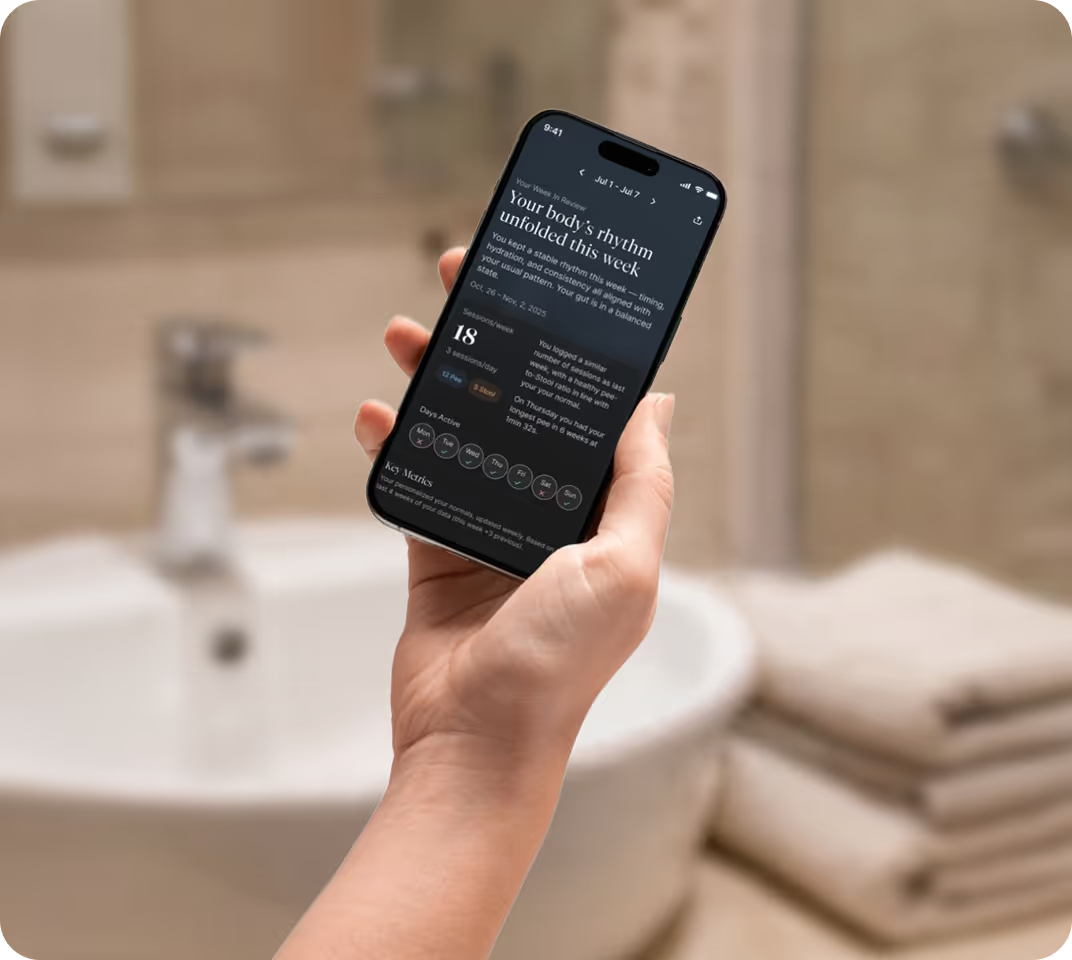
Your body files a report daily
You do your business. You see your data.
Every trip to the bathroom is data waiting to be read. Throne clips onto your toilet and reads every session automatically: stool consistency, frequency, hydration, and regularity, with no manual logging. So when something changes, you're comparing to your real baseline instead of guessing.
The hormone story, and what it can and can't claim
The usual explanation for more pooping on your period is prostaglandins, compounds your body releases to help the uterus contract and shed its lining. Because they act on smooth muscle, and the gut is lined with smooth muscle, the reasoning goes that they may also contribute to intestinal contractions and secretion, which would speed things up and loosen stool. Progesterone, which may slow gastrointestinal motility, drops as bleeding starts, which fits the flip from backed-up to loose that a lot of people notice in the days before their period.
That's a plausible and widely accepted mechanism, but it’s not 100% proven yet. The researchers who documented the day-one pattern were careful to say it's an association, and that they could not establish cause and effect. It's also still unknown whether prostaglandins made in the uterus even reach the gut, or whether the two just rise in parallel. The pattern is real and well measured.
The precise machinery behind it is still partly hypothesis, and any source stating it as settled fact is going further than the evidence does.
Since the mechanism isn't nailed down, no single explanation tells you what to expect for your body. Your own pattern does that better than the theory.
How common is this, really
Common enough that having it is fairly unremarkable.
In a study of 156 healthy women, about three-quarters reported at least one gastrointestinal symptom before or during their period. That figure covers all five symptoms they asked about, though, including abdominal pain and nausea, so it isn't a diarrhea-specific number. Diarrhea specifically was reported by roughly a quarter to just under a third, while abdominal pain was considerably more common.
Two things follow. First, period-related bathroom changes are a common experience, not a sign you're an outlier. Second, and worth naming gently, the same study found GI symptoms were more often reported alongside painful periods and alongside low mood or anxiety around menstruation. That doesn't mean the symptoms are in your head, and it doesn't establish that one causes the other.
Since stress alone can send you to the bathroom, it's simply useful context when you're deciding whether something is your normal or a change worth raising.
When it's more than a period thing
Cyclical bathroom changes that come and go with your period are usually just that. The reason to look closer is when the pattern doesn't fit, or when other things ride along with it.
A few situations deserve a real conversation with your doctor rather than taking a wait-and-see approach:
- Bowel changes so severe they disrupt your day, or diarrhea that leaves you dehydrated
- Blood in your stool, which is separate from menstrual blood and shouldn't be written off as part of your period
- Symptoms that don't settle once your period ends, or that are creeping worse cycle over cycle
- Severe pain, either abdominal or pelvic, beyond your usual cramps
- Unintended weight loss, fever, or waking at night with symptoms
If you have painful periods together with significant, cyclical bowel symptoms, especially pain when passing stool during your period, that combination can occur with endometriosis, including but not limited to endometriosis involving the bowel. It's not the likely explanation for most people, but it's the one standard advice overlooks, and endometriosis is routinely diagnosed years late, so it's worth raising directly if it sounds like you.
If you already have IBS, symptoms may become more noticeable around your period. People with inflammatory bowel disease may also feel more abdominal discomfort during menstruation, though that doesn't necessarily mean intestinal inflammation is worse. A recurring pattern is worth discussing with whoever manages your condition, but don't change an IBD treatment plan based on cycle timing without medical guidance.
Where tracking earns its place
"Is this normal for me?" is nearly impossible to answer from memory. This period may feel bad, but whether it's genuinely worse than usual or just more recent, you can't really say.
That's a pattern problem, and patterns are what get lost when you reconstruct them after the fact. Throne automatically records the bowel side of the picture, stool form and frequency, so you're not trying to remember every bathroom trip through cramps. Stool form is a useful proxy for intestinal transit, one aspect of bowel function that may shift around menstruation. Over a few cycles you can compare those trends against your own cycle dates instead of guessing, and a genuine change stands out against your baseline.
It won't tell you why, and it won't replace a clinician for anything persistent. What it does is turn "I think my period does this?" into something you can actually see, which is a stronger thing to bring to an appointment than a shrug. Throne's gut health coach can help you line the bowel pattern up with the rest of what you're noticing.
Frequently asked questions
Q: Is it normal to poop more on my period?
A: Yes. It's a commonly reported period-related symptom, and when measured daily it tends to peak on the first day of bleeding and ease over the following days. More frequent, looser stools around your period, without other worrying symptoms, is typical.
Q: Why does it happen right when my period starts rather than before?
A: The leading explanation is that prostaglandins, which help the uterus contract, also act on the gut, while progesterone (which had been slowing things down) drops as bleeding begins. That fits the common flip from constipated beforehand to loose once your period arrives. It's a biologically plausible and widely cited explanation, though it hasn't been directly established as the cause of period-related bowel changes in humans.
Q: Is period diarrhea a sign something is wrong?
A: Usually not. It's common and typically settles as your period winds down. What's worth checking is diarrhea severe enough to dehydrate you, blood in the stool, symptoms that don't resolve after your period, or a pattern getting worse over time.
Q: Could this be endometriosis or IBS?
A: It can be. Painful periods with significant cyclical bowel symptoms, particularly pain passing stool during your period, can occur with endometriosis, which is often diagnosed late. Existing IBS can also feel worse around menstruation. Standard advice tends to skip past both, so if either sounds like you, it's worth raising specifically.
Q: What can I actually do about it?
A: Mild changes often pass as your period progresses. If diarrhea, pain, or urgency regularly disrupts your day, ask a clinician about symptom-specific options rather than assuming it's something you just have to tolerate. Knowing your own pattern helps too, both for reassurance and for spotting when something has genuinely changed.
Exclusive Reader Offer
Take $50 off your Throne
Throne is the first hands-free sensor that automatically tracks your gut health, hydration, and urinary health, with every flush. Drop your email and we’ll send your $50-off code.
- Hands-free
- HSA/FSA eligible (saves 30%)
- 30-Day Battery
- 6 Private Profiles
Claim your $50
Thank you! Your submission has been received!
Oops! Something went wrong while submitting the form.
Judkins, T. C., Dennis-Wall, J. C., Sims, S. M., Colee, J., & Langkamp-Henken, B. (2020). Stool frequency and form and gastrointestinal symptoms differ by day of the menstrual cycle in healthy adult women taking oral contraceptives: A prospective observational study. BMC Women's Health, 20(1), 136. https://link.springer.com/article/10.1186/s12905-020-01000-x
Bernstein, M. T., Graff, L. A., Avery, L., Palatnick, C., Parnerowski, K., & Targownik, L. E. (2014). Gastrointestinal symptoms before and during menses in healthy women. BMC Women's Health, 14, 14. https://link.springer.com/article/10.1186/1472-6874-14-14
Lewis, S. J., & Heaton, K. W. (1997). Stool form scale as a useful guide to intestinal transit time. Scandinavian Journal of Gastroenterology, 32(9), 920-924. https://pubmed.ncbi.nlm.nih.gov/9299672/
Habib, N., Centini, G., Lazzeri, L., Amoruso, N., El Khoury, L., Zupi, E., & Afors, K. (2020). Bowel endometriosis: Current perspectives on diagnosis and treatment.
DISCLAIMER: This content is for informational purposes only and is not intended as medical advice. Throne products are not medical devices and are not intended to diagnose, treat, cure, or prevent any disease. Consult your physician with any health-related questions.