
Diarrhea at Night: Why It's Worth Paying Attention To
A single night of diarrhea usually isn't a concern. It's worth booking a visit if diarrhea during your sleeping hours keeps happening or keeps returning.
Written by
Thomas Nelson
Published on
July 29, 2026
Overview
A single night of diarrhea usually isn't a concern. It's worth booking a visit if diarrhea during your sleeping hours keeps happening or keeps returning.


Waking from sleep because you urgently need to have diarrhea is miserable. When it keeps happening, it's worth a closer look with your doctor, because true nighttime diarrhea can carry different implications from diarrhea that happens during the day or shortly after you wake up.
Not in a way that should scare you. Diarrhea that repeatedly wakes you from sleep is what doctors call an alarm or atypical feature. It can happen in IBS, but it's less typical and often leads doctors to check for other causes. It's a reason to get evaluated, but not a reason to panic.
One night of watery diarrhea is usually an acute problem, like a stomach bug or food poisoning. What doctors pay closer attention to is diarrhea that repeatedly wakes you from sleep over days or weeks, especially when it comes with blood, pain, fever, or weight loss.
Your body files a report daily
You do your business. You see your data.
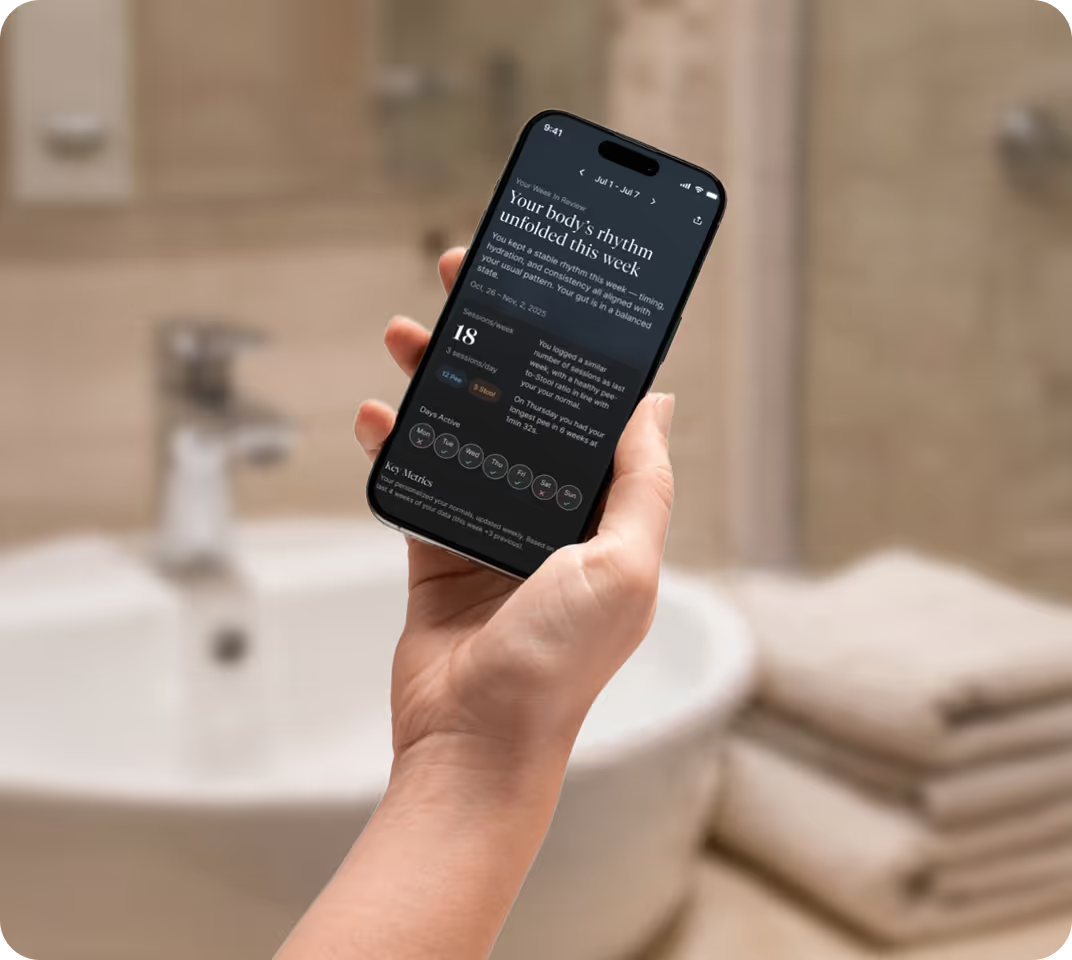
Every trip to the bathroom is data waiting to be read. Throne clips onto your toilet and reads every session automatically: stool consistency, frequency, hydration, and regularity, with no manual logging. So when something changes, you're comparing to your real baseline instead of guessing.
Understanding the timing
Your colon normally becomes less active during sleep. The large contractions that move stool toward the rectum become much less frequent overnight, then pick up again when you wake. That morning increase in activity is why many people have a bowel movement soon after getting up, which is normal and not the same thing as being woken up by diarrhea.
A recurring need to pass diarrhea despite that nighttime slowdown is something clinicians pay attention to. Symptoms that wake you from sleep sit on the list of alarm features that prompt doctors to look beyond IBS toward other causes like inflammation, microscopic colitis, infection, medication effects, or malabsorption. IBS itself tends to track with your waking day: meals, routine, and stress.
The diagnostic performance of these clues is modest. They raise the case for a closer look, but they don't identify precisely what the problem is, and many people with an ‘alarm’ feature don't have a dangerous condition. Don’t get worked up with worry, but do know that repeated nighttime diarrhea is a reason to get looked at, not something to wait out.
One bad night versus a pattern
There's a real difference between a single rough night and something that keeps happening.
A stomach bug or food poisoning can absolutely wake you up, and that's an acute illness running its course, not the alarm-feature situation. These usually come on fast, may bring vomiting or fever, and often begin improving within several days.
Diarrhea at night that keeps happening over weeks, or keeps coming back, is the pattern worth bringing to a doctor, especially if anything else about your bowel habits have changed. That said, even a single night deserves attention if it comes with severe pain, bleeding, confusion, or signs of dehydration.
Microscopic colitis: an important, easily missed cause
One cause of recurring watery diarrhea, particularly in middle-aged and older adults, is microscopic colitis.
It's a common cause of ongoing watery, non-bloody diarrhea, and the name explains why it's missed so often. The inflammation is only visible under a microscope, so the lining of the colon often looks normal or nearly normal during a colonoscopy, and diagnosis depends on examining tissue biopsies. That's why it gets mistaken for IBS, sometimes for years.
Its usual pattern fits this symptom closely: watery, non-bloody diarrhea, often with urgency and often at night. It's more common with age and more common in women, and it's been associated with several everyday medicines, including NSAID pain relievers, proton-pump inhibitors (a type of acid reducer), some antidepressants, and statins.
Those associations don't prove that a particular medication caused any one person's case, so this isn't a reason to stop anything on your own. Once microscopic colitis is found, it's treatable, which is why the biopsy is worth doing instead of settling for an IBS label.
Other causes to keep in mind
Inflammatory bowel disease, which includes Crohn's disease and ulcerative colitis, can cause diarrhea that wakes you, often alongside blood in the stool, belly pain, or weight loss. If that's your situation, our piece on 10 years with ulcerative colitis shares what living with it is actually like.
Beyond that, other causes of chronic diarrhea include bile-acid diarrhea, celiac disease, thyroid problems, medication effects, persistent infections, and, less commonly, long-standing diabetes affecting the nerves that control the gut. Some of these can produce nighttime symptoms, but the timing alone can't distinguish among them. That's what an evaluation is for, and you don't need to sort it out yourself.
Seeing your usual rhythm
Bathroom habits can be difficult to remember accurately over time. For general awareness, Throne automatically timestamps bathroom sessions and summarizes stool frequency, making it easier to see your usual routine and how it changes from day to day.
Throne does not evaluate symptoms, identify medical conditions, or tell you whether a change needs treatment. Persistent or concerning diarrhea should be discussed directly with a healthcare professional.
When to see a doctor
A single night from a stomach bug usually isn't a concern. It's worth booking a visit if diarrhea during your sleeping hours keeps happening or keeps returning, and sooner if it comes with:
- Blood in your stool, or black, tarry stools
- Weight loss you didn't plan
- Ongoing belly pain, fever, or night sweats
- Waking symptoms that have carried on for weeks
Get care promptly for blood in the stool, a high fever, severe belly pain, or signs of dehydration like dizziness or not being able to keep fluids down. None of these means the worst, but they're worth acting on rather than pushing through.
What a doctor’s visit might involve
A doctor’s visit usually starts with the pattern, not a procedure. Your doctor may ask when the diarrhea began, how frequently it happens, whether it occurs during the day as well as at night, and what the stool looks like. Expect questions about recent food and travel, antibiotics, prescription and over-the-counter medicines, other health conditions, and any family history of digestive disease. They may also check your temperature and hydration, examine your abdomen, and compare your current weight with previous measurements.
You may not need testing after one short-lived episode. When diarrhea persists, keeps returning, or comes with other concerning symptoms, blood tests can look for dehydration and clues to underlying conditions. Stool tests can check for blood, infection, parasites, inflammation, or other signs of disease. Additional testing depends on what the history and initial results suggest.
A colonoscopy is not automatically the first step. It may become appropriate when symptoms continue or a condition affecting the colon is suspected. If microscopic colitis is a possibility, biopsies are essential because the colon often looks normal during the procedure; the inflammation can only be identified by examining tissue under a microscope.
What you can do tonight
If this is one rough night and you otherwise feel okay, your first job is replacing what you’re losing. Take frequent small sips of water, broth, an electrolyte drink, or an oral rehydration solution. You don't need to force yourself to eat, but once your appetite returns, you can usually go back to your normal food.
Over-the-counter medicines such as loperamide or bismuth subsalicylate can help with uncomplicated acute diarrhea, but avoid them if you have blood in your stool or a fever. Follow the label, and check with a pharmacist or doctor first if you have other health conditions or take medications that could interact.
Don’t wait until morning if you cannot keep fluids down, feel faint or confused, are barely urinating, have severe abdominal pain, or see blood or black, tarry stool. Those can be signs of dehydration or another problem that needs prompt care.
Frequently asked questions
Q: Does diarrhea at night always mean something serious?
A: No. A stomach bug or food poisoning can wake you and clear up on its own. What's worth checking is a nighttime pattern that keeps happening or comes with blood, weight loss, or pain. It's a reason to get evaluated, not a diagnosis.
Q: Can IBS cause nighttime diarrhea?
A: The answer isn't an absolute no. IBS can sometimes cause nighttime symptoms. But diarrhea that repeatedly wakes you from sleep is considered atypical enough that doctors usually look for other explanations before assuming IBS is responsible.
Q: Why would I have diarrhea only at night, or first thing in the morning?
A: These are two different patterns. Diarrhea that wakes you from sleep is a nighttime symptom worth evaluating if it persists. Diarrhea that begins after you wake may just reflect the normal morning rise in colon activity, which is common. Either is worth raising if it's persistent, severe, or comes with other symptoms.
Q: What kind of doctor should I see?
A: Start with your regular doctor, who can do initial testing and refer you to a gastroenterologist if needed. If a nighttime pattern has gone on for weeks, it's better not to wait it out.
Exclusive Reader Offer
Take $50 off your Throne
Throne is the first hands-free sensor that automatically tracks your gut health, hydration, and urinary health, with every flush. Drop your email and we’ll send your $50-off code.
- Hands-free
- HSA/FSA eligible (saves 30%)
- 30-Day Battery
- 6 Private Profiles
Claim your $50
Thank you! Your submission has been received!
Oops! Something went wrong while submitting the form.
Savarino, E., Zingone, F., Barberio, B., Marasco, G., Akyuz, F., Akpinar, H., ... Barbara, G. (2022). Functional bowel disorders with diarrhoea: Clinical guidelines of the United European Gastroenterology and European Society for Neurogastroenterology and Motility. United European Gastroenterology Journal, 10(6), 556-584. https://onlinelibrary.wiley.com/doi/full/10.1002/ueg2.12259
Vasant, D. H., Paine, P. A., Black, C. J., Houghton, L. A., Everitt, H. A., Corsetti, M., ... Ford, A. C. (2021). British Society of Gastroenterology guidelines on the management of irritable bowel syndrome. Gut, 70(7), 1214-1240. https://www.gut.bmj.com/content/70/7/1214
Tome, J., Kamboj, A. K., & Pardi, D. S. (2021). Microscopic colitis: a concise review for clinicians. Mayo Clinic Proceedings, 96(5), 1302-1308. https://www.mayoclinicproceedings.org/article/S0025-6196(21)00246-9/fulltext
Nathani, R. R., Sodhani, S., & Goosenberg, E. (2025). Irritable bowel syndrome. In StatPearls. StatPearls Publishing. https://www.ncbi.nlm.nih.gov/books/NBK534810/
DISCLAIMER: This content is for informational purposes only and is not intended as medical advice. Throne products are not medical devices and are not intended to diagnose, treat, cure, or prevent any disease. Consult your physician with any health-related questions.