
Diarrhea Every Morning: What Timing Can Tell You
Having a bowel movement in the morning is normal. Having diarrhea every morning is a pattern that is worth understanding better.
Written by
Thomas Nelson
Published on
July 31, 2026

Overview
Having a bowel movement in the morning is normal. Having diarrhea every morning is a pattern that is worth understanding better.


Having a bowel movement in the morning is normal. Having loose or watery stool every morning is a pattern that is worth understanding better.
Your colon naturally switches into a more active mode when you wake up, then gets another push when you eat breakfast or drink coffee. That explains why diarrhea may happen at roughly the same time every day, but not what's making the stool loose in the first place.
The question isn't why it's the morning. It's what keeps meeting that morning push? Is it the coffee, breakfast, a medication, IBS, or another digestive issue?
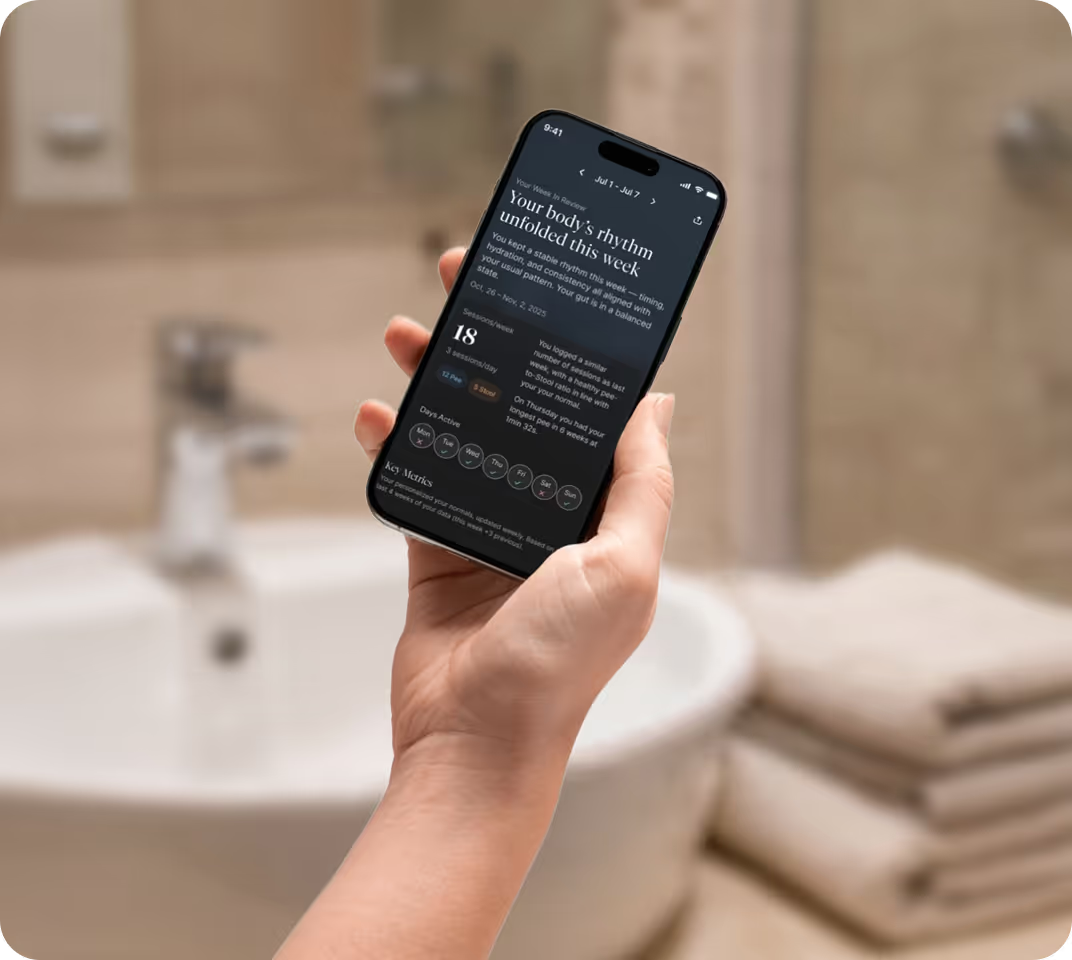
Your body files a report daily
You do your business. You see your data.
Every trip to the bathroom is data waiting to be read. Throne clips onto your toilet and reads every session automatically: stool consistency, frequency, hydration, and regularity, with no manual logging. So when something changes, you're comparing to your real baseline instead of guessing.
First: is it actually diarrhea?
Medically, diarrhea usually means loose or watery stools three or more times a day, or more often than is normal for you. But if you have one urgent, watery stool every morning, that's still a meaningful recurring change, even if it doesn't hit the strict textbook definition.
The answer to the question "is it normal to have diarrhea every morning" is a two parter. A morning bowel movement is normal. A consistently loose, watery, or urgent one isn't necessarily dangerous, but it also isn't just your body's normal morning rhythm, and it's worth looking into rather than assuming it's fine.
Why it happens in the morning
Two normal forces tee up a bowel movement in the morning. The first is the wake response: colonic activity is very low during sleep and rises sharply when you wake up, with the strong, propulsive contractions that create the urge to go becoming much more frequent after morning awakening.
The second is the gastrocolic reflex: eating or drinking stretches the stomach and signals the colon to move material that was already sitting there. It doesn't mean the breakfast you just ate raced through your whole digestive tract in ten minutes. It's just pushing older contents along, and it's especially active in the morning and after meals.
These reflexes explain the clock, but something else usually explains the consistency.
Which morning pattern do you have?
Noticing exactly when it hits narrows things down fast.
If it starts shortly after waking, before food or coffee, the normal wake response may just be revealing loose stool that was already in your colon. In that case, look at the day before: alcohol, a particular food, a medication, an illness, or an ongoing digestive condition.
If it starts after coffee or breakfast, the gastrocolic reflex is one likely trigger for the timing. Coffee itself can also stimulate colon activity in some people, and small studies suggest caffeine isn't the whole explanation. Coffee may be enough to trigger the loose stool on its own, or it may amplify an underlying tendency toward diarrhea.
If it wakes you from sleep, this is likely not the same as diarrhea that starts after you wake up, and the difference is key. Being repeatedly pulled out of sleep to go is an atypical feature that shifts attention toward causes like inflammation, microscopic colitis, infection, or bile-acid diarrhea.
What may be making the stool loose
Once you know the timing, the real work is finding what keeps meeting that morning push. It helps to go by clues rather than a long disease list.
A repeated morning trigger. If it happens at the same time every morning, look for something else that happens at the same time every morning:
- Coffee
- Breakfast, especially a food you react to
- Sugar-free gum, drinks, or sweeteners
- A medication, laxative, or magnesium-containing supplement
- Alcohol the night before
IBS with diarrhea. IBS becomes more plausible when morning diarrhea is part of a longer pattern that includes recurrent abdominal pain associated with bowel movements, along with bloating, urgency, mucus, and symptoms that come and go over time. The gastrocolic response may be exaggerated in some people with IBS, and stress can amplify it, but "stress causes diarrhea" shouldn't be used to dismiss the diarrhea.
One important caution: a painless loose morning stool is not automatically IBS. IBS involves that characteristic pain pattern.
Food intolerance or malabsorption. A repeated breakfast can create a repeated reaction. Lactose, fructose, and sugar alcohols are common examples. The move here is to notice consistency, not to launch into a giant elimination diet.
Bile-acid diarrhea. This one is underdiagnosed and worth knowing. Bile-acid diarrhea can look a lot like IBS-D, often produces urgent watery diarrhea after meals, and deserves particular thought after gallbladder removal or disease affecting the end of the small intestine. It's common enough among people labeled with IBS-D that it's specifically worth asking about.
If urgent watery diarrhea repeatedly follows breakfast, especially after gallbladder removal, it's one possibility to raise with a clinician, not something to diagnose yourself.
When it started suddenly. If the pattern is new and comes with nausea, vomiting, fever, recent travel, questionable food, or sick contacts, a viral stomach bug or food poisoning moves up the list. That kind usually runs its course over a few days.
When it has continued for weeks. Diarrhea lasting around four weeks or longer is considered chronic and broadens the evaluation to causes like celiac disease, inflammatory bowel disease, microscopic colitis, bile-acid diarrhea, thyroid problems, and medication effects. These are reasons to get checked, not a list to frighten yourself with.
What "explosive" tells you
"Explosive" describes how urgent, forceful, watery, or gassy a bowel movement feels. It doesn't identify a cause on its own, and it isn't a separate condition.
So if yours feels explosive, come back to the same clues: did it follow coffee or breakfast? Is there a lot of gas or cramping? Did it start suddenly? Is it happening outside the morning too? Are there any red flags below? Those questions tell you far more than the force of it does.
A one-week pattern check
This is where you can actually get somewhere. For about a week, jot down:
- When you woke up
- Whether diarrhea came before or after eating or drinking
- Coffee and alcohol
- What was in breakfast
- Medications and supplements, and when you took them
- Stool form
- Urgency, pain, nausea, or bloating
- Whether anything ever woke you from sleep
Then change one likely trigger at a time. Skip coffee for a few mornings, for instance, rather than dropping coffee, dairy, gluten, fiber, and breakfast all at once, which tells you nothing about which one mattered. One thing not to do on your own: don't stop a prescription medication to test it. Talk to the prescriber first.
Where Throne fits
Morning diarrhea feels predictable, but memory tends to flatten the details. Throne timestamps your sessions and tracks stool form and frequency, so it can show exactly when the bowel movements happened, how loose they were, and whether the pattern stayed in the morning or started spreading through the day.
It can't tell whether coffee, IBS, bile acids, or something else is behind it, so you can add context such as coffee, breakfast, medications, and symptoms yourself. Do that, and you have a far more useful record to bring to a clinician than a vague sense that mornings are rough.
When to see a doctor
Give your doctor a call if genuinely watery diarrhea continues for more than a few days without improving, or if morning diarrhea:
- Happens most mornings or keeps coming back
- Is disrupting your work, travel, eating, or daily life
- Started after a new medication
At four weeks, it's considered chronic and should be evaluated, so there's no reason to keep waiting to see if it passes.
Seek care sooner if you have red or black stool, unintentional weight loss, fever, severe or persistent abdominal pain, signs of dehydration, repeated nights of being woken by diarrhea, or greasy, pale, hard-to-flush stool. Evaluation for ongoing diarrhea usually starts with a detailed history and medication review, blood tests including celiac screening, and often a stool test for inflammation. Further testing depends on your symptoms and risk factors.
Frequently asked questions
Q: Why do I have diarrhea every morning when I wake up?
A: The colon quiets down overnight and becomes much more active when you wake, which can bring on a bowel movement soon after you're up. If it's loose, the wake response is exposing stool that's already loose for another reason. This is different from being woken from sleep by diarrhea, which is a more concerning pattern worth evaluating.
Q: Why do I have diarrhea every morning after I eat?
A: Eating triggers the gastrocolic reflex, which tells your colon to move material along to make room. It's moving older contents, not the breakfast you just ate passing straight through. If what comes out is consistently loose, look at what you eat or drink each morning, coffee included.
Q: Is it normal to have diarrhea every morning?
A: A morning bowel movement is normal. A consistently watery or urgent one isn't necessarily dangerous, but it's not just your natural rhythm either, and it's worth understanding rather than dismissing.
Q: Why is my morning diarrhea explosive?
A: "Explosive" describes urgency and a lot of liquid or gas. It's a description, not a diagnosis. The useful clues are the timing, what preceded it, and whether any red flags are present.
Q: Can coffee cause diarrhea every morning?
A: It can. Coffee stimulates colon activity in some people, and even decaf can do it, so it's not purely the caffeine. Often coffee is exposing an existing sensitivity rather than being the sole cause, which a few coffee-free mornings can help you check.
Q: Why do I have diarrhea and nausea every morning?
A: A new pattern with nausea can fit a stomach bug, food poisoning, a medication effect, or another trigger. If the combination keeps up for more than a few days without improving, or becomes a steady pattern, it's worth getting evaluated.
Exclusive Reader Offer
Take $50 off your Throne
Throne is the first hands-free sensor that automatically tracks your gut health, hydration, and urinary health, with every flush. Drop your email and we’ll send your $50-off code.
- Hands-free
- HSA/FSA eligible (saves 30%)
- 30-Day Battery
- 6 Private Profiles
Claim your $50
Thank you! Your submission has been received!
Oops! Something went wrong while submitting the form.
Narducci, F., Bassotti, G., Gaburri, M., & Morelli, A. (1987). Twenty four hour manometric recording of colonic motor activity in healthy man. Gut, 28(1), 17-25. https://pubmed.ncbi.nlm.nih.gov/3817580/
Malone, J. C., & Thavamani, A. (2023). Physiology, gastrocolic reflex. In StatPearls. StatPearls Publishing. https://www.ncbi.nlm.nih.gov/books/NBK549888/
Rao, S. S. C., Welcher, K., Zimmerman, B., & Stumbo, P. (1998). Is coffee a colonic stimulant? European Journal of Gastroenterology & Hepatology, 10(2), 113-118. https://pubmed.ncbi.nlm.nih.gov/9581985/
Brown, S. R., Cann, P. A., & Read, N. W. (1990). Effect of coffee on distal colon function. Gut, 31(4), 450-453. https://pmc.ncbi.nlm.nih.gov/articles/PMC1378422/
Vasant, D. H., Paine, P. A., Black, C. J., Houghton, L. A., Everitt, H. A., Corsetti, M., ... Ford, A. C. (2021). British Society of Gastroenterology guidelines on the management of irritable bowel syndrome. Gut, 70(7), 1214-1240. https://www.gut.bmj.com/content/70/7/1214
Fernández-Bañares, F. (2022). Carbohydrate maldigestion and intolerance. Nutrients, 14(9), 1923. https://pubmed.ncbi.nlm.nih.gov/35565890/
DISCLAIMER: This content is for informational purposes only and is not intended as medical advice. Throne products are not medical devices and are not intended to diagnose, treat, cure, or prevent any disease. Consult your physician with any health-related questions.