
Is Pooping Once a Week Normal? What Your Pattern Can Tell You
Pooping once a week is below the range that the large majority of healthy adults report, and it meets the low-frequency mark for constipation. It’s not usually an emergency on its own though.
Written by
Thomas Nelson
Published on
August 3, 2026
Overview
Pooping once a week is below the range that the large majority of healthy adults report, and it meets the low-frequency mark for constipation. It’s not usually an emergency on its own though.


Pooping once a week is not within the usual range for most adults. It meets one of the standard signs of constipation, even if you don't feel completely "blocked."
But the number is only our starting point. A soft bowel movement that passes easily and has been your lifelong pattern is different from suddenly going once a week with hard stool, straining, bloating, pain, or the feeling that you never fully empty. Those details tell you whether you're dealing with an unusual baseline, everyday constipation, or something worth investigating with your doctor.
Your body files a report daily
You do your business. You see your data.
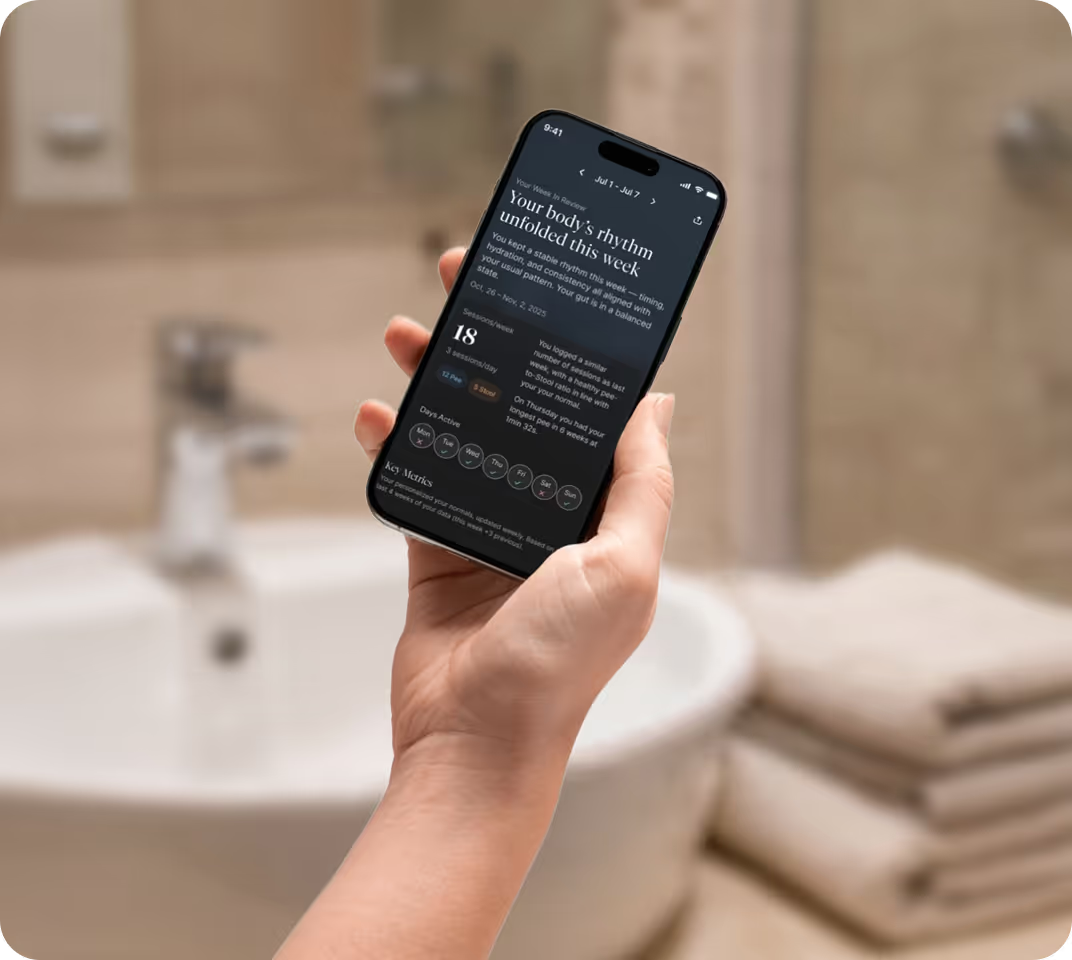
Every trip to the bathroom is data waiting to be read. Throne clips onto your toilet and reads every session automatically: stool consistency, frequency, hydration, and regularity, with no manual logging. So when something changes, you're comparing to your real baseline instead of guessing.
Is pooping once a week normal?
The short answer: it's below the range that the large majority of healthy adults report, and it meets the low-frequency mark for constipation. It’s not usually an emergency on its own though.
In a representative US sample, about 96% of adults who considered their bowel habits normal went somewhere between three times a week and three times a day. Once a week sits below that.
Once-weekly bowel movements do occur, but they're unusual. In one community study, about 1% of women reported going once a week or less. That doesn't make the pattern automatically dangerous, but it does put it well outside the usual range, so it's worth looking at in context rather than waving off as "just how I'm built" or a temporary thing.
The context that matters most is whether this is your steady, comfortable lifelong pattern or a recent change, and whether symptoms come with it. A new or symptomatic once-a-week pattern deserves more attention than a longstanding, easy one.
Your weekly number isn't a diagnosis
Frequency is only one piece. Before you decide how concerned to be, run through the rest:
- Is the stool hard, dry, lumpy, or unusually large?
- Do you strain to pass it?
- Does it hurt?
- Do you feel fully emptied afterward?
- Are you bloated or uncomfortable between bowel movements?
- Has the pattern recently changed?
- Do you need laxatives or suppositories to go at all?
This is why someone can be constipated while going fairly often, or go infrequently without much distress. Standard definitions of constipation include hard stool, painful or difficult passage, and incomplete emptying right alongside low frequency.
There's even a slightly surprising research finding here: among adults being evaluated for constipation, harder stool correlates moderately with slower measured transit, while the frequency count alone is a poor guide.
Frequency tells you how often the door opens. Stool form and symptoms tell you what's happening behind it.
Why you may only be pooping once a week
It helps to think of infrequent bowel movements as patterns rather than a long list of diseases.
Not enough stool bulk, or a disrupted routine: A low-fiber diet, a change in what or when you eat, less movement, travel, and repeatedly ignoring the urge can all slow things down. Adequate fluid matters, especially if you're dehydrated or adding fiber, but drinking gallons isn't a cure for constipation, and "just drink more water" oversimplifies it.
Something you take is slowing things down: A number of common medications and supplements constipate, including opioid pain relievers, some antacids, iron, certain antidepressants, anticholinergic drugs, and some blood-pressure medications. If your pattern changed after starting or increasing one, that's a strong clue. Don't stop a prescription on your own, though. Talk about your concerns with the prescriber.
Slow-transit constipation: Here, material moves through the colon unusually slowly, which can mean infrequent urges, bloating, and difficult bowel movements. It's a real possibility, but not the automatic meaning of going once a week. Frequency alone can't establish it, which is part of why measured transit and a simple stool count don't line up neatly, and a clinician may need more than the number.
The stool reaches the end, but the muscles don't release: Pelvic-floor or defecatory dysfunction becomes more likely when you feel the urge but can't get the stool out, strain heavily, feel blocked, have to change position or use a finger to help, and rarely feel empty. This is a different problem from stool simply moving slowly, and piling on more fiber doesn't necessarily fix it.
IBS with constipation: IBS-C fits when constipation is part of a recurring pattern of abdominal pain tied to bowel movements, often with bloating and stool that changes form over time. Infrequent but painless pooping shouldn't be labeled IBS on its own.
Medical causes worth checking: These include hypothyroidism, diabetes, celiac disease, neurological conditions, pregnancy-related changes, structural problems, and other metabolic issues. This isn't a list to panic over. It's the reason a new or persistent pattern is worth a basic medical look.
Where does all the food go?
A natural worry is "where does all the food go?" Your small intestine still absorbs nutrients as usual, and the colon gradually receives what's left: fiber residue, bacteria, mucus, and shed cells. Slower movement through the colon gives it more time to absorb water, which can leave stool drier and harder to pass, part of why an infrequent pattern can also be an uncomfortable one.
Stool does accumulate when you go less often, but it isn't a neat stack of seven separate meals, and what you eat doesn't map meal-for-meal onto what you pass.
Is pooping once a week bad?
It can become a problem, but it’s the symptoms rather than the number that tell the story. It's worth acting on when the stool is hard or painful, you're regularly straining, you feel bloated or never fully emptied, or the pattern is new. The frequency by itself doesn't prove damage is being done, but once a week is infrequent enough that it shouldn't be dismissed when symptoms are present.
Ongoing constipation can lead to hemorrhoids, anal fissures, and, at the more severe end, fecal impaction. These are possibilities to prevent, not inevitabilities.
Let’s be clear though, having infrequent bowel movements doesn’t mean your body is “filling with toxins” or that your blood is being poisoned.
A two-week check
Because the number alone tells you so little, a short record is the most useful thing you can do. For two weeks, note:
- The date and time of every bowel movement
- Stool form (the Bristol scale works well)
- Whether you strained
- Any pain
- Whether you felt fully emptied
- Urges you ignored
- Medications and supplements
- Any changes in fiber
- Bloating
- Any laxatives you used
Throne timestamps your sessions and tracks stool form and frequency, which makes it easier to confirm whether you're truly going once a week and whether the pattern has shifted. It can't measure straining, pain, or incomplete emptying, so you'd add those details yourself. Together, that's a far more useful picture to bring to a clinician than a vague sense that things are slow.
What to try
If there are no red flags below, a few staged, evidence-based steps are reasonable.
Respond to the urge when it comes rather than repeatedly putting it off. Aim for a regular toilet window, often after breakfast, when the colon is naturally more active. Add fiber gradually, especially soluble fiber like psyllium, if your intake is likely low, and keep fluids adequate as you do. Move regularly. And review any constipating medications with a pharmacist or clinician.
If basic changes aren't enough, this is worth a conversation with your doctor. For adults with chronic idiopathic constipation, current AGA and ACG guidance strongly recommends polyethylene glycol (PEG), an osmotic laxative.
Psyllium, magnesium oxide, and senna are supported too, though with less certain evidence, while bisacodyl is mainly for short-term or rescue use. Because once-a-week pooping can have several different causes, ask a pharmacist or clinician which approach fits your pattern rather than stacking products yourself.
Going once a week for an extended stretch is a reason to build a plan, not to keep waiting until you feel desperate and reach for a one-off rescue.
When to see a doctor
Arrange a routine visit if going once a week:
- Is a new change for you
- Continues despite reasonable self-care
- Comes with consistently hard or painful stool
- Involves regular straining or never feeling empty
- Has you relying on laxatives repeatedly
- Is disrupting your eating, work, exercise, or daily life
Seek urgent care now for severe or constant abdominal pain, repeated vomiting, an inability to pass gas, or an increasingly swollen abdomen.
Contact a clinician promptly for rectal bleeding or blood in the stool, fever, unexplained weight loss, anemia, or a persistent new change in your bowel habits.
Frequently asked questions
Q: Is pooping once a week normal?
A: It's outside the usual range and meets one sign of constipation. How concerning it is depends on your symptoms and whether it's a change from your baseline, not on the number alone.
Q: Is pooping once a week bad?
A: Not automatically dangerous, but it can become a problem when the stool is hard, painful, or difficult to pass, or when it comes with bloating and a feeling of incomplete emptying.
Q: Why am I only pooping once a week?
A: Common reasons include diet or routine changes, medications, slow colonic transit, pelvic-floor dysfunction, IBS-C, or an underlying condition like thyroid disease. The pattern of symptoms points toward which one.
Q: Can you be constipated without feeling constipated?
A: Yes. Low frequency on its own can count as a constipation sign even without much pain, though frequency alone doesn't reveal the cause or how severe it is.
Q: How long is too long without pooping?
A: There's no universal countdown. Symptoms matter more than the exact day. Severe pain, vomiting, a swollen belly, or an inability to pass gas need prompt care regardless of how many days it's been.
Q: Should I take a laxative if I only poop once a week?
A: An evidence-based over-the-counter option can be reasonable, but a recurring once-a-week pattern is worth discussing with a clinician rather than leaning on rescue laxatives indefinitely.
Exclusive Reader Offer
Take $50 off your Throne
Throne is the first hands-free sensor that automatically tracks your gut health, hydration, and urinary health, with every flush. Drop your email and we’ll send your $50-off code.
- Hands-free
- HSA/FSA eligible (saves 30%)
- 30-Day Battery
- 6 Private Profiles
Claim your $50
Thank you! Your submission has been received!
Oops! Something went wrong while submitting the form.
Mitsuhashi, S., Ballou, S., Jiang, Z. G., Hirsch, W., Nee, J., Iturrino, J., Cheng, V., & Lembo, A. (2018). Characterizing normal bowel frequency and consistency in a representative sample of adults in the United States (NHANES). American Journal of Gastroenterology, 113(1), 115-123. https://pubmed.ncbi.nlm.nih.gov/28762379/
Heaton, K. W., Radvan, J., Cripps, H., Mountford, R. A., Braddon, F. E., & Hughes, A. O. (1992). Defecation frequency and timing, and stool form in the general population: a prospective study. Gut, 33(6), 818-824. https://pubmed.ncbi.nlm.nih.gov/1624166/
Saad, R. J., Rao, S. S., Koch, K. L., Kuo, B., Parkman, H. P., McCallum, R. W., ... Hasler, W. L. (2010). Do stool form and frequency correlate with whole-gut and colonic transit? Results from a multicenter study in constipated individuals and healthy controls. American Journal of Gastroenterology, 105(2), 403-411. https://pubmed.ncbi.nlm.nih.gov/19888202/
Chang, L., Chey, W. D., Imdad, A., Almario, C. V., Bharucha, A. E., Diem, S., ... Sultan, S. (2023). American Gastroenterological Association-American College of Gastroenterology clinical practice guideline: Pharmacological management of chronic idiopathic constipation. Gastroenterology, 164(7), 1086-1106. https://pubmed.ncbi.nlm.nih.gov/37211380/
Mawer, S., & Alhawaj, A. F. (2023). Physiology, defecation. In StatPearls. StatPearls Publishing. https://www.ncbi.nlm.nih.gov/books/NBK539732/
Malone, J. C., & Thavamani, A. (2023). Physiology, gastrocolic reflex. In StatPearls. StatPearls Publishing. https://www.ncbi.nlm.nih.gov/books/NBK549888/
Vasant, D. H., Paine, P. A., Black, C. J., Houghton, L. A., Everitt, H. A., Corsetti, M., ... Ford, A. C. (2021). British Society of Gastroenterology guidelines on the management of irritable bowel syndrome. Gut, 70(7), 1214-1240. https://www.gut.bmj.com/content/70/7/1214
National Institute of Diabetes and Digestive and Kidney Diseases. Symptoms & causes of constipation. https://www.niddk.nih.gov/health-information/digestive-diseases/constipation/symptoms-causes
DISCLAIMER: This content is for informational purposes only and is not intended as medical advice. Throne products are not medical devices and are not intended to diagnose, treat, cure, or prevent any disease. Consult your physician with any health-related questions.