
Why Does My Pee Smell Like Coffee?
"My pee smells like coffee" after drinking coffee is a far better explanation than hunting for a rare disease based on an odor. But there are a few situations where the smell is worth a second look.
Written by
Thomas Nelson
Published on
July 31, 2026

Overview
"My pee smells like coffee" after drinking coffee is a far better explanation than hunting for a rare disease based on an odor. But there are a few situations where the smell is worth a second look.


If your pee smells like coffee not long after you drank coffee, the coffee is the most likely explanation.
Your body absorbs the compounds in coffee, breaks them down, and sends some of them and their byproducts out through your urine. The smell on its own is generally not a sign that anything is wrong.
It's more useful as a timeline clue than a health signal: "I had two cups this morning and noticed it at noon" is a far better explanation than hunting for a rare disease based on an odor. Here's why it happens, how to confirm coffee is the cause, and the few situations where the smell is worth a second look.
Your body files a report daily
You do your business. You see your data.
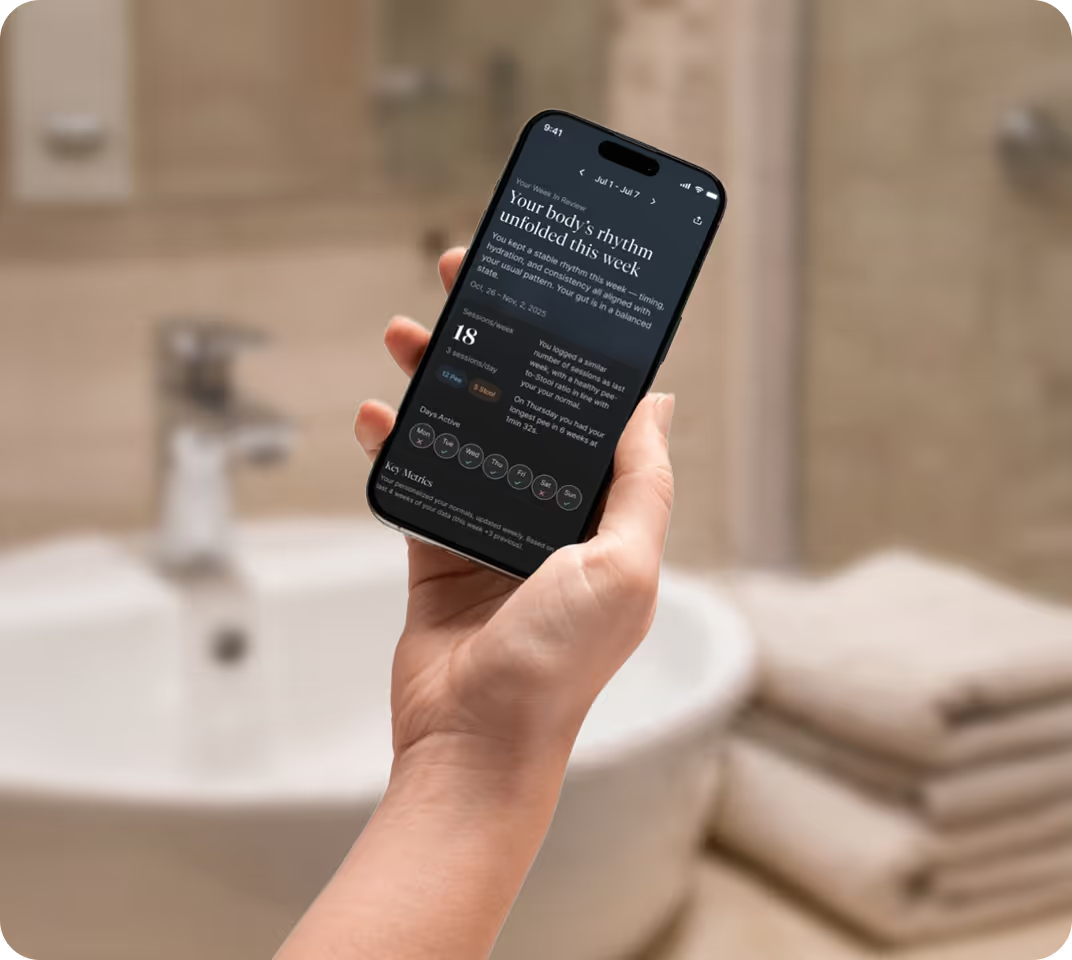
Every trip to the bathroom is data waiting to be read. Throne clips onto your toilet and reads every session automatically: stool consistency, frequency, hydration, and regularity, with no manual logging. So when something changes, you're comparing to your real baseline instead of guessing.
Why your pee may smell like coffee
Coffee contains a lot of different compounds, including caffeine, chlorogenic acids, and hundreds of others from the plant. When you drink it, your body absorbs and transforms many of them, and your kidneys clear some of the results into your urine. Researchers can identify coffee consumption from characteristic metabolites that show up in urine. That confirms coffee leaves a measurable chemical trail, though it doesn't tell us which compound, if any, produces the recognizable smell.
Coffee sends a range of its byproducts into your urine, and for some people the result smells a bit like coffee. But there's no single proven "coffee-smell chemical," and you don't need one to explain what you're noticing. A coffee-like smell is just one of several odors urine can take on, like a popcorn note or something fishy, each with its own reasons.
Why some people notice it more
Whether you notice it at all seems to come down to a few things: how much coffee you drank, how strong it was, how recently, how sensitive your nose is, and how concentrated your urine happens to be. These are reasonable contributors rather than precise predictors, so it's not worth reading much into exactly how strong it is on a given day.
Concentration is the one worth understanding. Urine is mostly water carrying dissolved waste, so when there's less water and more waste, the color is darker. Concentrated urine often has a stronger overall odor too, so it's reasonable to think it could make a coffee-like note easier to notice, though that specific effect hasn't been studied directly. Color is part of what your pee can tell you.
Does coffee dehydrate you?
A common myth is worth correcting here. Caffeine can make you pee a bit more for a while, but coffee still delivers fluid. In a controlled study of 50 habitual male coffee drinkers, four cups spread across the day produced no meaningful difference in hydration compared with the same amount of water. That doesn't mean coffee affects everyone identically, but it does undermine the idea that a moderate amount automatically dehydrates you.
The smell can still stand out more if coffee is replacing most of the other fluids you'd normally drink, or if your urine is concentrated for another reason like a hot day or not drinking much. If concentrated urine is amplifying the odor, drinking normally may make it less noticeable.
How to check whether coffee is responsible
You can test the obvious explanation without any equipment.
Notice whether the smell reliably follows coffee. Drink fluids the way you normally would, without forcing down extra water. Then see whether it goes away on a day, or a stretch, when you haven't had coffee. If the smell repeatedly follows coffee and fades when coffee is out of the picture, that makes coffee the likely explanation. It's a pattern check, not a diagnostic test, and for someone who otherwise feels fine, it's usually all that's needed.
What it probably doesn't mean
A few common worries are worth addressing directly.
It doesn't mean coffee is "passing straight through you," and it doesn't mean your kidneys are damaged. What's in your urine is filtered waste and byproducts, not brewed coffee taking a shortcut. Removing water-soluble waste and metabolites is a normal kidney function, but urine odor by itself can't tell you how well your kidneys are working, in either direction.
It doesn't point to a urinary tract infection on smell alone. A bladder infection is more meaningfully suggested by symptoms such as burning, urgency, needing to go often, lower belly discomfort, and cloudy, bloody, or strong-smelling urine, not a coffee-like odor by itself. A strong smell can happen with an infection, but the odor alone is weak evidence.
And it isn't the same as sweet or fruity urine. People use "coffee-like" to mean all sorts of things: roasted, bitter, nutty, or just strong. A genuinely sweet or fruity smell is a different question with different causes, so it's best not to fold a roasted, coffee-ish smell into that one.
When it may be something else
The coffee explanation gets weaker in a few specific situations, and these are the ones worth acting on:
- The smell keeps up even when you haven't had coffee for a while
- It's actually foul, fishy, strongly ammonia-like, or sweet rather than recognizably coffee-like
- It comes with burning, urgency, cloudy or bloody urine, or lower belly pain, which fit a bladder-infection picture and are worth a call
- There's fever, chills, back or side pain, nausea, or vomiting, which raise concern for a kidney infection and deserve prompt care
The simplest way to hold this: act on the symptoms around the smell, not on the fact that it resembles coffee.
Where Throne fits
Throne records the timing and frequency of your bathroom visits and can show broader changes in your urinary pattern. It can't smell your urine or know when you drank coffee, so you'd still make that connection yourself. For this particular question, the simple timeline, coffee consumed and odor noticed afterward, is usually the most useful information.
Frequently asked questions
Q: Is coffee-smelling pee bad for me?
A: Usually not. If the smell clearly follows coffee and you otherwise feel well, with no burning, pain, fever, or blood, it's likely related to the coffee rather than a health problem. The smell by itself isn't a sign of anything wrong.
Q: Does it mean I'm dehydrated?
A: Not on its own. Coffee doesn't automatically dehydrate you. Concentrated, darker urine can make any smell stronger, so if your urine is dark and you've had little else to drink, normal hydration will usually tone it down.
Q: How long should the smell last?
A: There's no well-established timetable for the odor itself. It should generally track with recent coffee rather than persist on its own. If it continues across coffee-free days, or comes with urinary symptoms, the coffee explanation becomes less convincing.
Q: Could it be a UTI?
A: A UTI is much better signaled by burning, urgency, going often, lower belly discomfort, and cloudy or bloody urine than by odor. A coffee-like smell on its own, with none of those, points to coffee, not infection.
Exclusive Reader Offer
Take $50 off your Throne
Throne is the first hands-free sensor that automatically tracks your gut health, hydration, and urinary health, with every flush. Drop your email and we’ll send your $50-off code.
- Hands-free
- HSA/FSA eligible (saves 30%)
- 30-Day Battery
- 6 Private Profiles
Claim your $50
Thank you! Your submission has been received!
Oops! Something went wrong while submitting the form.
Stalmach, A., Mullen, W., Barron, D., Uchida, K., Yokota, T., Cavin, C., Steiling, H., Williamson, G., & Crozier, A. (2009). Metabolite profiling of hydroxycinnamate derivatives in plasma and urine after the ingestion of coffee by humans: identification of biomarkers of coffee consumption. Drug Metabolism and Disposition, 37(8), 1749-1758. https://pubmed.ncbi.nlm.nih.gov/19460943/
Kostelnik, S. B., Davy, K. P., Hedrick, V. E., Thomas, D. T., & Davy, B. M. (2021). The validity of urine color as a hydration biomarker within the general adult population and athletes: A systematic review. Journal of the American College of Nutrition, 40(2), 172-179. https://pubmed.ncbi.nlm.nih.gov/32330109/
Killer, S. C., Blannin, A. K., & Jeukendrup, A. E. (2014). No evidence of dehydration with moderate daily coffee intake: a counterbalanced cross-over study in a free-living population. PLOS ONE, 9(1), e84154. https://pubmed.ncbi.nlm.nih.gov/24416202/
Bono, M. J., Leslie, S. W., & Reygaert, W. C. (2024). Uncomplicated urinary tract infections. In StatPearls. StatPearls Publishing. https://www.ncbi.nlm.nih.gov/books/NBK470195/
DISCLAIMER: This content is for informational purposes only and is not intended as medical advice. Throne products are not medical devices and are not intended to diagnose, treat, cure, or prevent any disease. Consult your physician with any health-related questions.